Cognitive Development in Infants & Toddlers
260 likes | 1.19k Views
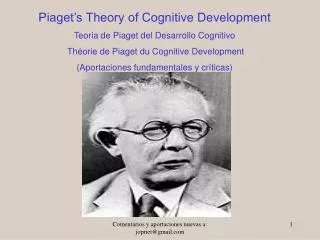
Cognitive Development in Infants & Toddlers. Chapter 5. Piaget’s Theory of Genetic Epistemology. Child is an active seeker of information Major Themes Method Clinique (clinical method) Constructivism Schemes (Schemata) Organization Adaptation Reflective Abstraction.


Cognitive Development in Infants & Toddlers
E N D
Presentation Transcript
Piaget’s Theory of Genetic Epistemology • Child is an active seeker of information • Major Themes • Method Clinique (clinical method) • Constructivism • Schemes (Schemata) • Organization • Adaptation • Reflective Abstraction
Piaget’s Theory of Genetic Epistemology • Method Clinique • Pose problem to the child • Observe child’s attempt to solve the problem • Probe with questions to determine underlying strategy and information needed to solve the problem • Problems: • With prelinguistic infants, inferences must be made
Piaget’s Theory of Genetic Epistemology • Constructivism • Each experience is represented in a unique way by each individual • Construction of representation is based on: • History • Strategy • Social/Environmental support
Piaget’s Theory of Genetic Epistemology • Scheme (Schemata) • Organized representation of • Actions (e.g. reflexes) • Thoughts (e.g. concepts) • Processes (e.g. problem solving strategies) • Schemata provide the framework with which we interpret new experiences and construct new schemata or integrate new information into existing schemata
Piaget’s Theory of Genetic Epistemology • Organization • Across development Schemata are constantly differentiated and integrated • Schemata are organized into increasingly complex systems • Organizations may reflect hierarchical or network organizations
Piaget’s Theory of Genetic Epistemology • Adaptation • Tendency of the organism to modify itself to meet environmental demands • System seeks equilibrium with its environment through two processes • Assimilation • Accommodation • Process of reaching equilibrium is termed equilibration
Piaget’s Theory of Genetic Epistemology • Reflective Abstraction • Process of construction of an internal representation from external stimuli • Recognition or awareness of some external stimulus • Processing the stimulus in one’s working memory (controlled) • Modification (accommodation) of cognitive structures (schemata) to form a representation of experience
Piaget’s Theory of Genetic Epistemology • Stages of Cognitive Development • Qualitatively different ways of knowing the world • Sequence is universal • Timing of onset of each stage is unique and depends on • Neurological maturation • Experience with others and the outside world
Piaget’s Theory of Genetic Epistemology • Sensorimotor (Infancy-Early toddlerhood) • Preoperational (Early childhood) • Concrete Operational (Middle childhood) • Formal Operational (Adolescence)
Piaget’s Theory of Genetic Epistemology • Characteristics of Sensorimotor Thought • Knowledge is based on direct sensory and motor experience • Mental representation is based on direct representation of sensory and motor experience • Symbolic representation emerges late in the stage • Key accomplishments: • Person permanence • Object permanence • Symbolic representation • Sense of intentionality and primitive cause-effect
Piaget’s Theory of Genetic Epistemology • Stages of Sensorimotor Thought • Primary Reflexes • Primary Circular Reactions • Secondary Circular Reactions • Coordination of Secondary Schemes • Tertiary Circular Reactions • Transition to Symbolic Thought
Language Development in Infancy & Toddlers • What is language? • Semanticity—symbolic representation of object, actions, events, concepts • Productive—seemingly infinite combinations of words that lead to utterances that can be understood • Displacement—allows reference to objects, actions, events, and concepts in their absence • Arbitrary—no direct relationship between the sound and structure of a word and the object, action, event, or concept it represents
Language Development in Infancy & Toddlers • Structures of Language • Phonology/Grapheme • Morphology • Syntax • Semantics • Pragmatics
Language Development in Infancy & Toddlers • Theories of Language Development • Learning/Environmental Theories • Skinner—Operant Conditioning • Bandura—Vicarious Learning (modeling and imitation) • Nativist Theory • Chomsky—Language Acquisition Device (innate structure containing universals of language)
Language Development in Infancy & Toddlers • Nativist Theory • All physiologically intact humans have capacity to develop language • Unclear whether non-human animals develop language • Physical structures specialized for language • Wernicke’s area—comprehending words and producing spoken and written langauge • Broca’s area—production of speech • Sensitive periods render the young child at an advantage in learning language
Language Development in Infancy & Toddlers • Nativists critiqued based on • Lack of evidence of innate knowledge of “universals of language” • Lack of experimental studies to refute nativists’ assumptions (depravation studies)
Language Development in Infancy & Toddlers • Interaction Theories: • Cognitive: • Language and cognition are directly linked • As cognitive development proceeds, children move through increasingly complex representational systems (e.g. object permanence to utterances) • Connectionist or Network models seem to be most persuasive for the cognitive approach; increased complexity of networks are linked to increased facility with language (support from empirical rsch and computer simulations
Language Development in Infancy & Toddlers • Social Interactionist • Biopsychosocial Model of language development • Interactions with others in the environment (ala Vygotsky’s ideas) • Appropriate stimulation during sensitive periods • Corrections provide feedback and expansion without negative demeanor • Child’s gestures coupled with words are accepted and recast • Code-switching
Language Development in Infancy & Toddlers • Precursors to Language Development in Infancy • Perceptual skills—auditory acuity and discrimination • Social interactions—opportunities to hear the native language • Shared attention to distinctive features [directed by competent language user]
Language Development in Infancy & Toddlers • Development of Language through Infancy and Toddlerhood • Prelinguistic • Neonates: reflexive, non-intentional sounds • Young infants (roughly the first 2-4 months) • Variation in cries • Distinctive sounds indicating pleasure • Gazing with apparent intent
Language Development in Infancy & Toddlers • Development of Language through Infancy and Toddlerhood • Linguistic/Comunicative • Gestures coordinated with sounds (6 to 8months) • Babbling with presence of syllables (consonant-vowel repetitions; cross cultural) • Echolalia (immediate repetition of words—8-12 months) • Can begin to link gestures with one-word utterances to establish communicative competence
Language Development in Infancy & Toddlers • http://www.nidcd.nih.gov/health/voice/ speechandlanguage.asp#mychild