Download
1 / 32
320 likes | 586 Views
Absolutism and the State Supreme. “I would rather obey a fine lion, much stronger than myself, than two hundred rats of my own species.” - Voltaire . I. It’s good to be the king ...sometimes. The strange childhood of Louis XIV b. 1638 r. 1643-1715

E N D
Absolutism and the State Supreme “I would rather obey a fine lion, much stronger than myself, than two hundred rats of my own species.”- Voltaire
I. It’s good to be the king ...sometimes The strange childhood of Louis XIVb. 1638 r. 1643-1715 Era of RegentsCardinal RichelieuAnne of AustriaMazarin “foreigners”
Put away these childish things… The Fronde, 1649-52 Monarchy v. the Parlements Paris Nobles Peasants The lesson…?
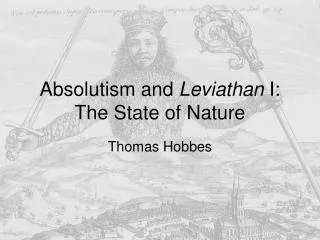
“Life is nasty, brutish and short” Thomas Hobbes - Leviathan, 1660 Absolutism“It is not wisdom but Authority that makes a law”
Perils of Progress Wars of religion & colonization Price Revolution Enclosure
III. Absolutism? Absolutely! A well conducted government must have an underlying concept so well integrated that it could be likened to a system of philosophy…All financial, political and military matters must flow towards one goal…the strengthening of the state and the furthering of its power. - Frederick II “The Great” d. 1786
Enlightened despotism King James(VI & I) True Law of Free Monarchies – 1598 - material/spiritual well-being- sacred obedience- sovereignty lies in the monarch Joseph II of Austria1780-1790 Philosophes
“Servant of the state” Philosophes Frederick the Great Joseph II
A. The Renaissance1350-1650 Machiavelli The Prince 1513 How things are v. how they ought to be
B. The Reformation • Religion and nationalism- Fragmentation v. universalism - Appeal to the Christian Nobility of the German Nation 1521
C. Decline in Church Primacy 1. State Sovereignty- Henry VIII, Act of Supremacy 1535- Charles V, Peace of Augsburg 1555- Peace of Westphalia 1648
D. Decline of medieval “empires” 1. Ottoman Empire Suleiman the Magnificentr. 1520-1566 Battle of Lepanto 1571
2. Poland “elective monarchy” - frontier-less- anti-Semitism
3. Spain Philip II r. 1550-1598 Revolt of the Netherlands The Spanish Armada (1588)
A. France • Henry IVd. 1610 Edict of Nantes 1598monopolies 2. Cardinal Richelieud. 1642 (Louis XIII)intendantsHabsburg warsFrance before individuals, classes, or ChurchMazarin
The Sun King Louis XIV 3. “I am the state”dismissed assembliesdirect rule / appointmentsprofessional armyGallicanism Edict of Fontainebleau 1685 Jansenism
4. King’s Men bourgeois bureacracyJean-Baptiste Colbertmercantilism
5. “I have loved war too much” Natural borders AlliancesHabsburgsWar of the League of AugsburgWar of Spanish Succession
B. Cult of personality Versailles
Catherine Palace Sanssouci
R & D • Science and the state- Académie des Sciences 1666 - Royal Academy 1660 Christopher Wren. d. 1723
The Grand Embassy 1697-98 Peter Mikhailov
C. Czar of all the Russias 1. Peter I “The Great” 1689-1725- Westernization - Baltic expansion St. Petersburg- state service of nobles- serfs as slaves Romanovs Eastern Expansion
2. Catherine “the Great”r. 1762-1796- un-Enlightenment 1773 revolt- southern, western expansion
D. Germany stirs • HRE? • Reformation • Westphalia 1648 • Siege of Vienna 1683 Leopold I r. 1657-1705Habsburg Dynasty
Austrian Habsburg Dynasty Maria Teresa 1740-1780Joseph II 1780-1790- religious toleration- abolished torture- equality before the law- abolished serfdom
2. Hohenzollerns(Prussia)- militarism / state serviceFrederick William I
So…. Absolute rulers helped early modern states negotiate fundamental social and economic change… …but Absolutism itself would become the target of reformers.