Download
1 / 47
470 likes | 2.13k Views
Module 3 Introduction Content Area: Analytical Epidemiology Essential Question (Generic): Is there an association between the hypothesized cause and the disease?

E N D
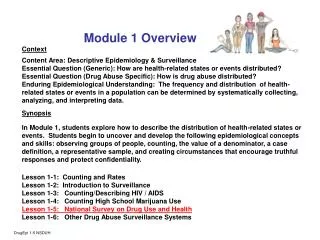
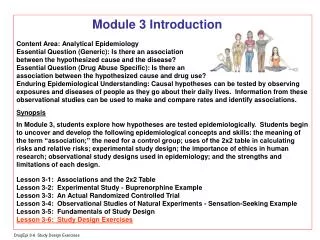
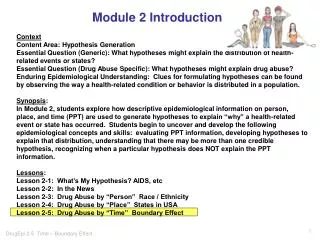
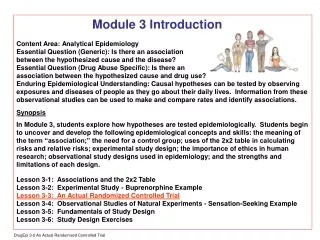
Module 3 Introduction Content Area: Analytical Epidemiology Essential Question (Generic): Is there an association between the hypothesized cause and the disease? Essential Question (Drug Abuse Specific): Is there an association between the hypothesized cause and drug use? Enduring Epidemiological Understanding: Causal hypotheses can be tested by observing exposures and diseases of people as they go about their daily lives. Information from these observational studies can be used to make and compare rates and identify associations. Synopsis In Module 3, students explore how hypotheses are tested epidemiologically. Students begin to uncover and develop the following epidemiological concepts and skills: the meaning of the term “association;” the need for a control group; uses of the 2x2 table in calculating risks and relative risks; experimental study design; the importance of ethics in human research; observational study designs used in epidemiology; and the strengths and limitations of each design. Lesson 3-1: Associations and the 2x2 Table Lesson 3-2: Experimental Study - Buprenorphine Example Lesson 3-3: An Actual Randomized Controlled Trial Lesson 3-4: Observational Studies of Natural Experiments - Sensation-Seeking Example Lesson 3-5: Fundamentals of Study Design Lesson 3-6: Study Design Exercises
Module 3 - Analytical Epidemiology • Lesson 3-1 Associations and the 2x2 Table • Content • Introduction to the concept of “association” • Diagram and explanation of descriptive versus analytical epidemiology and how each relates to hypothesized associations • Introduction to the 2x2 table and its use in testing hypotheses • Practice in labeling and understanding the 2x2 table with examples of hypothesized associations • Big Ideas • An association is when two things “turn up together” • Epidemiologists study associations • Descriptive epidemiology generates hypotheses about associations and analytical epidemiology tests hypotheses about associations • The 2x2 table is a tool used to express the numbers of people with and without the exposure and with and without the outcome. In this way it includes controls. This project is supported by a Science Education Drug Abuse Partnership Award, Grant Number 1R24DA016357-01, from the National Institute on Drug Abuse, National Institutes of Health.
Where are we? Essential Questions Enduring Understandings
… associated with each other Association Found Between Coffee and Pancreatic Cancer
Handout Association Found Between Coffee and Pancreatic Cancer
… associated with each other Tied Related Associated Linked What do we mean when we say that there is anassociationbetween two things? Things that are associatedare linked in some way that makes themturn up together.
Things That Turn Up Together Things that are associated are linked in some way that makes themturn up together.
Things That Turn Up Together Suicide Higher in Areas with Guns Smoking Linked to Youth Eating Disorders Family Meals Are Good for Mental Health Study Links Iron Deficiency to Math Scores Study Concludes: Movies Influence Youth Smoking Lack of High School Diploma Tied to US Death Rate Study Links Spanking to Aggression Depressed Teens More Likely to Smoke Snacks Key to Kids’ TV- Linked Obesity: China Study Breakfast Each Day May Keep Colds Away Pollution Linked with Birth Defects in US Study Kids Who Watch R-Rated Movies More Likely to Drink, Smoke
Review - Descriptive Epidemiology Epidemiologic studies that are concerned with characterizing the amount and distribution of health and disease within a population Descriptive epidemiology can generate hypothesesabout associations
New Topic - Module 3 is about Analytical Epidemiology Epidemiologic studies that are concerned with determinants of disease and the reasons for relatively high or low frequencies of disease in specific population subgroups Analytical epidemiology can test hypothesesabout associations
Generate Test Descriptive Epidemiology Analytical Epidemiology Epidemiology and Associations (This connects everything) Hypothesis about associations An unproven idea, based on observation or reasoning, that can be supported or refuted through investigation An educated guess Hypotheses in epidemiology are statements that suggest associations between an exposure and an outcome
Generate Test Descriptive Epidemiology Analytical Epidemiology Epidemiology and Associations (An example) Hypothesis about associations Describes observations of kids who drink and smoke “turning up” at R-rated movies Hypothesis: Watching R-rated movies can influence teenagers to smoke and drink alcohol Scientifically studies the association between teenage drinking and smoking and going to R-rated movies to test whether the hypothesis is refuted or supported
The 2x2 Table The 2x2 table is a tool used to express the numbers of people with and without the exposure and with and without the outcome.
Contingency Table A cross-classification of data where categories of one variable are presented in rows and categories of another variable are presented in columns. The simplest contingency table is the 2x2 table
Outcome / Disease Exposure 2x2 Table Not Smoking Total Smoking Are there controls in this 2x2 table? If yes, where are they? a b Watching R-rated movies c d Not watching R-rated movies
Control Group People who participate in a study and do not have the exposure of interest People whose results are compared to the group that was exposed.
No Outcome Outcome Total Exposed Not Exposed What is Important to Understand So Far . . . Analytic Epidemiology Tests hypotheses Need for an unexposed comparison group 2x2 table can express relationships between exposure and outcome Analytical Epidemiology / Study Design
In the News Suicide Higher in Areas with Guns Smoking Linked to Youth Eating Disorders Family Meals Are Good for Mental Health Study Links Iron Deficiency to Math Scores Study Concludes: Movies Influence Youth Smoking Lack of High School Diploma Tied to US Death Rate Study Links Spanking to Aggression Depressed Teens More Likely to Smoke Snacks Key to Kids’ TV- Linked Obesity: China Study Breakfast Each Day May Keep Colds Away Pollution Linked with Birth Defects in US Study Kids Who Watch R-Rated Movies More Likely to Drink, Smoke
2 x 2 Table Suicide Higher in Areas with Guns Total a b c d
2 x 2 Table Suicide Higher in Areas with Guns No Suicide Suicide Total Areas with Guns a b c d Areas without Guns
2 x 2 Table Suicide Higher in Areas with Guns No Suicide Suicide Total a b Areas with Guns a b c d Areas without Guns People who are exposed
2 x 2 Table Kids Who Watch R-Rated Movies More Likely to Drink, Smoke Total a b c d
2 x 2 Table Kids Who Watch R-Rated Movies More Likely to Drink, Smoke Do Not Drink & Smoke Drink & Smoke Total R-Rated Movies a b c d No R-Rated Movies
2 x 2 Table Kids Who Watch R-Rated Movies More Likely to Drink, Smoke Do Not Drink & Smoke Drink & Smoke Total a R-Rated Movies a b c d No R-Rated Movies People who are exposed and have the outcome
2 x 2 Table Family Meals Are Good for Mental Health Total a b c d
2 x 2 Table Family Meals Are Good for Mental Health Good Mental Health Poor Mental Health Total Family Meals a b c d No Family Meals
2 x 2 Table Family Meals Are Good for Mental Health Good Mental Health Poor Mental Health Total Family Meals a b c d d No Family Meals People who are not exposed and do not have the outcome
2 x 2 Table Study Links Iron Deficiency to Math Scores Total a b c d
2 x 2 Table Study Links Iron Deficiency to Math Scores Poor Math Scores Good Math Scores Total Iron Deficiency a b c d No Iron Deficiency
2 x 2 Table Study Links Iron Deficiency to Math Scores Poor Math Scores Good Math Scores Total Iron Deficiency a b c d d No Iron Deficiency People who do not have the outcome and are not exposed
2 x 2 Table Pollution Linked with Birth Defects in US Study Total a b c d
2 x 2 Table Pollution Linked with Birth Defects in US Study No Birth Defects Birth Defects Total Pollution a b c d No Pollution
2 x 2 Table Pollution Linked with Birth Defects in US Study No Birth Defects Birth Defects Total Pollution a b c c d d No Pollution People who are not exposed
2 x 2 Table Depressed Teens More Likely to Smoke Total a b c d
2 x 2 Table Depressed Teens More Likely to Smoke Do Not Smoke Smoke Total Depression a b c d No Depression
2 x 2 Table Depressed Teens More Likely to Smoke Do Not Smoke Smoke Total b Depression a b c d d No Depression People who do not have the outcome
2 x 2 Table Smoking Linked to Youth Eating Disorders Total a b c d
2 x 2 Table Smoking Linked to Youth Eating Disorders No Eating Disorders Eating Disorders Total Smoke a b c d Do Not Smoke
2 x 2 Table Smoking Linked to Youth Eating Disorders No Eating Disorders Eating Disorders Total b Smoke a b c d Do Not Smoke People who are exposed and do not have the outcome
2 x 2 Table Study Links Spanking to Aggression Total a b c d
2 x 2 Table Study Links Spanking to Aggression No Aggression Aggression Total Spanking a b c d No Spanking
2 x 2 Table Study Links Spanking to Aggression No Aggression Aggression Total a Spanking a b c c d No Spanking People who have the outcome
2 x 2 Table Snacks Key to Kids’ TV-Linked Obesity Total a b c d
2 x 2 Table Snacks Key to Kids’ TV-Linked Obesity No Obesity Obesity Total Snacks a b c d No Snacks
2 x 2 Table Snacks Key to Kids’ TV-Linked Obesity – China Study No Obesity Obesity Total Snacks a b c c d No Snacks People who are not exposed and have the outcome
Re-Cap • Big Ideas in this Lesson (3-1) • An association is when two things “turn up together” • Epidemiologists study associations • Descriptive epidemiology generates hypotheses about associations and analytical epidemiology tests hypotheses about associations • The 2x2 table is a tool used to express the numbers of people with and without the exposure and with and without the outcome. In this way it includes controls. This project is supported by a Science Education Drug Abuse Partnership Award, Grant Number 1R24DA016357-01, from the National Institute on Drug Abuse, National Institutes of Health.
Where are we? Next Lesson In the next Lesson, 3-2, students will learn about how an experimental study can test hypotheses between an exposure and a beneficial health-related effect 6. Hypothesis: Buprenorphine will stop heroin addicts from using heroin.