Download
1 / 41
630 likes | 1.82k Views
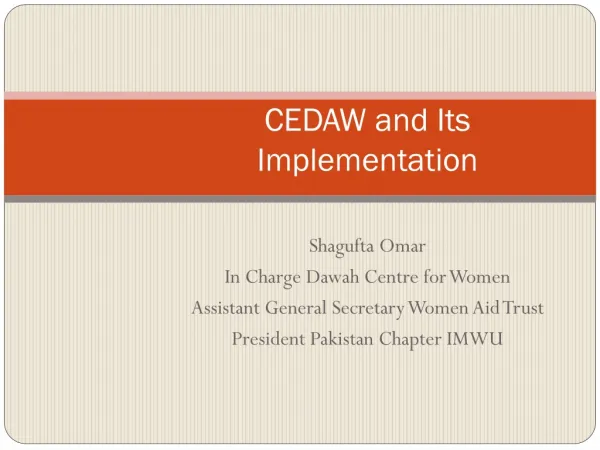
CEDAW and Its Implementation. Shagufta Omar In Charge Dawah Centre for Women Assistant General Secretary Women Aid Trust President Pakistan Chapter IMWU. CEDAW: International Human Right Treaty on Women Issues.

E N D
CEDAW and Its Implementation Shagufta Omar In Charge Dawah Centre for Women Assistant General Secretary Women Aid Trust President Pakistan Chapter IMWU
CEDAW: International Human Right Treaty on Women Issues • CEDAW is the abbreviation of ‘Convention on Elimination of all forms of Discrimination Against Women’ • CEDAW was adopted on 18th Dec. 1979 vide Resolution 34/180 and came into force on 3 Sep. 1981 after two years of its adoption • An International Multilateral, open ended treaty • A blueprint for all efforts for the attainment of women’s rights globally • Is signed by 98 states and has 187 party states • Legally binding on state parties, “United Nations, Treaty Series , vol. 1249, p. 13” • Pakistan joined the convention in 1996 by accession (Binding)
An Introduction to CEDAW • Background of CEDAW • Short History of CEDAW • United Nations Commission on the Status of Women (UNCSW) and the Development of CEDAW • Objectives of CEDAW • Introduction to the Articles of CEDAW • Acceptability of CEDAW • Ratifications to CEDAW • Controversies Regarding CEDAW
Background of CEDAW • Adopted by UN General Assembly for legal implementation of the Declaration on the Elimination of Discrimination against Women • Culmination of more than 30 years of work by UNCSW established in 1946, which elaborated • Convention on the political rights of women 1952 • Convention on the Nationality of Married Women • Convention on Consent to Marriage, Minimum Age and Registration of Marriages 1962 • Declaration on the Elimination of Discrimination against Women in 1967
Implications on signatory states • to incorporate the principle of equality of men and women in their legal system, abolish all discriminatory laws and adopt appropriate ones prohibiting discrimination against women; • to establish tribunals and other public institutions to ensure the effective protection of women against discrimination; and • to ensure elimination of all acts of discrimination against women by persons, organizations or enterprises
Execution and Implementation Self executing treaties Merely becoming a party the treaty and all of its obligations come in action Treaties requiring ‘implementing legislation’ A change in the domestic law of a state party will direct or enable it to fulfill treaty obligations Art.2 of CEDAW requires adoption of appropriate legislative and other measures It is not self executing 6
Choice of Differing Provision Formulation of Reservations A state may when signing, ratifying or acceding to a treaty formulate a reservation unless it is prohibited by the treaty Must be included at the time of signing, ratification or accession. A party cannot add a reservation after it has already joined a treaty Reservations on CEDAW of 62 countries are available on record, a treaty with the highest number of reservations Unilateral statement purporting to exclude or modify the legal obligation and its effects on the reserving state Few countries withdrew their reservations and others made changes on ratification Objections of 23 countries on ‘Reservation on CEDAW’ are available on record 7
Preamble of CEDAW Affirms faith in fundamental Human Rights Principle of inadmissibility of discrimination Right of all human beings for dignity, freedom without distinction based on sex Considering early conventions on civic and political, and economic social and cultural rights Showing concerns over present discriminations and state of affairs in many areas 8
30 Articles of CEDAW and Its Contents Part I (Articles 1 to 6) Part II (Articles 7 to 9) Part III (Articles 10 to 14) Part IV (Articles 15 to 16) Part V (Articles 17 to 22) Part VI (Articles 22 to 30) 9
Article I Definition of discrimination The Convention defines discrimination against women as "...any distinction, exclusion or restriction made on the basis of sex which has the effect or purpose of impairing or nullifying the recognition, enjoyment or exercise by women, irrespective of their marital status, on a basis of equality of men and women, of human rights and fundamental freedoms in the political, economic, social, cultural, civil or any other field." 10
Article 2 Condemns discrimination against women and pursues to adopt the policy of eliminating it to incorporate the principle of equality of men and women in their legal system, abolish all discriminatory laws and adopt appropriate ones prohibiting discrimination against women; to establish tribunals and other public institutions to ensure the effective protection of women against discrimination; and to ensure elimination of all acts of discrimination against women by persons, organizations or enterprises 11
Article 3 and 4 Providing for appropriate measures and legislation to ensure full dev. and advancement of women on equal grounds (Article 3) Adoption of special temporary measures aimed to accelerate de facto equality between the two sexes (Article 4) Any adopted measures aimed at protecting maternity shall not be considered discriminatory(Article 4) 12
Article 5 and 6 Modifying of social and cultural patterns of conduct eliminating prejudices and customary practices (Article 5) Understanding of maternity responsibilities and recognition of common responsibility for this (Article 5) Measures and legislation to suppress all forms of women trafficking and exploitation of prostitution of women (Article 6) 13
Articles 7 to 12 Article 7, Political participation and representation Article 8, International representation Article 9, Nationality issues Article 10, Education and related matters Article 11, Employment matters Article 12, Health care facilities specially family planning and maternity related issues 14
Articles 13 to 16 Article 13, eliminating discrimination in economic and social life Article 14, issues of rural women Article 15, equality of legal rights Article 16, marriage and family rights on equal grounds Entering into marriage Choice of spouse Same rights during marriage and at the time of dissolution Same parental rights irrespective of marital status 15
Administrative mechanism Articles 17, establishment of committee consisting of 8 members at the time of entry into force After ratification of or succession to by 35th state, of 23 experts, elected by state parties Election process is described in detail 16
Report Submission, Article 18 Report to be submitted to Secretary General of UN for consideration by the committee Within one year after the entry Every 4 years or whenever requested by the committee Indicating factors and difficulties affecting fulfillments of obligations of Convention 17
Articles 19 to 26 • Articles 19, 20 & 21, committee’s rules and procedures • Article 22, 23, 24, for implementation of various provisions, specialized agencies role is envisaged • Article 25, terms for signatures by states • Article 26, provision for request of revision
Articles 27 to 30 Article 27, enter into force mechanism Article 28, provision of reservation permissibility Article 29, Any dispute between two or more states be submitted to arbitration or later referral to ICJ At the time of signature or ratification or accession can declare not to be bound by this article Article 30, text in 6 languages deposited with the Secretary General of UN 19
Acceptability of CEDAW Ratifications to CEDAW Highest number of ratifications Till date 99 signatories and 187 state parties Reservations to CEDAW Highest number of reservations, 62 on record Out of 194 member states 7 have not ratified(USA, Sudan, Iran, Somalia (Muslim states), Nauru, Palau,, Tonga (small pacific Island nations) 20
Basis of Reservations to CEDAW Incompatibility with existing national legislation Non compliance with Shariah (Islamic Law) Political reasons Economic reasons 21
Reservations and Declarations by State Parties Amongst the 62 states 37 have placed reservation on article 29 (1), which is specifically mentioned in the treaty for the possible reservation. This article deals with the complaint mechanism considering any dispute of implementation amongst different state parties. 22
Reservations and Declarations by State Parties Preamble paragraphs 10 and 11, Articles 1, 2, 2(d), 2 (e), 2(f), 2(g), 4(1), 5(a), 5(b), 7(a), 7(b), 9, 9(1), 9(2), 11, 11(1), 11(1b,c,d), 11(2), 13, 13(a), 14(2c), 14(2h), 15, 15(2), 15(3), 15(4), 16, 16(1), 16 (1a), 16(1c), 16(1d), 16(1e), 16(1f), 16(1g), 16(1h), 16(2), 2(a), 9(2), 16(c), 16(d), 16(h), and Generally worded declarations such as “Subject to Shariah Law” and “Subject to the Constitution of the State”. 23
Reservations and Declarations by Muslim States Amongst Muslim states 26 state parties have entered one or more reservations. These are: Algeria, Bahrain, Bangladesh, Brunei Darussalam, Egypt, Indonesia, Iraq, Jordan, Kuwait, Lebanon, LibyanArabJamahiriya, Malaysia, Maldives, Mauritania, Mauritius, Morocco, Niger, Oman, Pakistan, Qatar, Saudi Arabia, Syrian Arab Republic, Tunisia, Turkey, United Arab Emirates and Yemen 24
Reservations and Declarations by Non Muslim States Amongst non Muslim state parties a total number of 37states have entered one or more reservations. These are: Argentina, Australia, Austria, Bolivarian republic, Bahamas, Brazil, Chile, China, Cuba, Democratic People’s Republic of Korea, El Salvador, Ethiopia, France, Germany, India, Ireland, Israel, Italy, Jamaica, Lesotho, Liechtenstein, Malta, Mexico, Micronesia, Monaco, Myanmar [Burma], Newzealand, Netherlands, Republic of Korea, Singapore, Spain, Switzerland, Thailand, Trinidad and Tobago, UK of Great Britain and Northern Ireland, Venezuela, Viet Nam. 25
Controversies Regarding CEDAW Promoting Western-Style radical feminism Promoting Western values and style of life Propagation for legalization of abortions Supporting decriminalization of prostitution Supporting anti-family agenda(encouraging single mothers) Supporting same sex marriages Against state sovereignty 26
International Application of CEDAW Beijing conference in 1995 (Fourth Int’l women conference) 45000 women participated from all over the world Declared rights were demanded New rights were demanded which startled the world Right to homosexuality Right to nudity Right for prostitution as sex worker Right for abortion (reproductive rights) Beijing + 5 in 2000 in New York and UN Sessions onwards
Beijing Platform of Action (BPA) 12 Areas of Concern, in the Light of CEDAW Poverty of women Education of women Equal job opportunities Health facilities for women Media and women Political participation of women Institutional set up for women Violence against women
Beijing Platform of Action (Cont’d.) War and women International representation of women Environment and women Girl child Disabled women (added by Pakistan)
Implementation of CEDAW • Implementation Mechanism • Committee on the Elimination of Discrimination against Women (CEDAW Committee) • Optional Protocol To .CEDAW 1999 • Implementation success
Committee on the Elimination of Discrimination against Women (CEDAW Committee) • Committee Members (23 Experts) • Committee Meetings/Sessions (2 or 3 annual sessions) • Reporting System of Committee • Initial report by state parties • Periodic report after 4 years • Comments and General Recommendations by Committee (25 GR till 2007 to clarify or stress particular issues)
Optional Protocol to CEDAW 1999 • Adopted at New York, 6 October 1999 • Entered into force on 22 December 2000 • Status : Signatories : 79. Parties : 99 • A treaty or Int’l agreement supplementing a previous treaty is called protocol. Parties to the earlier agreements are not required to adopt to the protocol, for this it is sometimes mentioned as optional protocol • It provided a unique implementation mechanism for international HR instruments, by allowing for receiving and reviewing individual complaints • Enabled committee to initiate suomoto inquiries on situations of grave violations of women’s rights
Pakistan’s position to CEDAW Pakistan's accession on 12th March 1996,with reservation Declaration: "The accession by [the] Government of the Islamic Republic of Pakistan to the [said Convention] is subject to the provisions of the Constitution of the Islamic Republic of Pakistan." Reservation:(ICJ) "The Government of the Islamic Republic of Pakistan declares that it does not consider itself bound by paragraph 1 of article 29 of the Convention." 33
Pakistan After Accession to the Covenant in 1996 Inquiry commission on the status of women was set up in 1994 (After an inclination to sign) with its report in 1997 Recommendations of the commission (those contrary to Islamic teachings) Inclusion of UN and other family laws Provision of Reproductive rights Equal inheritance, evidence, De'yat and guardianship Inheritance for the widow of the deceased son Right to marry irrespective of any religion To treat marital rape as crime and accord punishment 34
Pakistan After Accession to the Covenant in 1996 (contd.) Establishment of NCSW in 2000 Mandate and Reports of NCSW Huddod Ordinance Disas-o-Dyat Absolute right of Divorce for women (in process) Amendment in criminal laws in the name of Women Protection Act (WPA) 2007 (amended Hadd-e-Zina Ordinance, Hadd-e-Qazaf ordinance, PPC, CrPc, Dissolutions of Muslim marriage act DMMA1939) National plan of action (NPA) Gender Reform Action Plan (GRAP) Setting up of Women Studies Dept. with Master program in major Universities 35
Awareness Campaign in Pakistan • Translations of convention prepared by NGO’s • Part of training for women councilors' (Local Govt.) • MNA’s MPA’s orientation program • Workshops conducted by Ministry of Women Development (MOWD) for empowerment of women at various levels • Similar programs by various NGO’s in coordination with International Specialized Agencies • Women Studies Dept. with Master program in major Universities • Media Campaign incorporating the scheme and theme of the convention
Institutions Working for Women’s Rights for Implementation of CEDAW • International • UNCSW- United Nation’s Commission on the Status of Women • DAW-Division for the Advancement of Women • CONGO-Coalition of Non Govt. Organizations • National • MOWD-Ministry of Women Development • NCSW- National Commission on the Status Of Women • NGLS- Non Government Liaison Service
Western Concept of Gender Equality • Equal status, rights and obligations • Sameness of attitudes, behavior patterns and actions towards both sexes • No discrimination in any of the fundamental rights • Negation of any roles stereotype • Sameness of role distribution
Application of Western concept of gender Equality to an Islamic society • Contradictions with Islamic philosophy • Variation in role distribution • Variation in some of the rights with reference to role distribution • Variation in required religious obligations (ibadah) • Variation in dress code
Points to Ponder • Should the reservations on CEDAW by Muslim countries /Pakistan be continued or removed ? • Should domestic legislation necessarily be carried on in all regards suggested by CEDAW? • Is measuring gender equality with respect to economic contribution to society’s development correct? • Does proving capabilities of working in all the fields is required for a woman’s recognition?
Points to Ponder (Cont’d.) • Should the western strategies under the global women’s right movement be blindly followed or should they be adapted to suit our religious value system? • What should be the responsibilities of family, society and government in assisting women for performing her dual role? • What should be the focus of awareness concerning CEDAW?