Advancements in SKA: Exploring Cosmic Structures and Reionization at Sub-Arcsecond Resolution
450 likes | 607 Views
The Square Kilometre Array (SKA) aims to revolutionize our understanding of the universe by providing sub-arcsecond resolution at 1.4 GHz. This study reveals RMS sensitivity of 23 nJy in just 8 hours, enabling detailed imaging of cosmic phenomena, including star and black hole formation, protoplanetary disks, and the Epoch of Reionization. Leveraging phased arrays and advanced telescopic concepts, SKA will also probe high-redshift radio sources and study cosmic structure evolution. Access full insights into the revolutionary science enabled by SKA.


Advancements in SKA: Exploring Cosmic Structures and Reionization at Sub-Arcsecond Resolution
E N D
Presentation Transcript
SKA in context z=8
Fields of View 1deg^2 With Full Sensitivity at subarcsec resolution
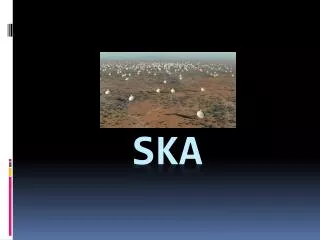
China KARST Canada LAR US Large-N+Small-D Australia Luneburg Lenses Europe: phased array Australia: Cylindrical Telescopes India: Preloaded parabolas • “White Papers” issued • for each concept in 2002 • Reviewed by EMT/ISAC and revised 2003
Concept USA: ‘Nd’ • 4640 x 12m parabolic antennas • Full Xcorr inner 2300 ants (35 km), outer ‘stations’ of 13 ants • Advantage: works to high frequency (> 20 GHz) • Disadvantage: no ‘full-sky, full-array’ multibeaming
SKA poster (multi-beams) Advantages: many simultaneous beams, fast response Disadvantage: Max. frequency = 1.4 GHz Disadvantage: max freq = 1.4 GHz
SKA and VLBI “SKV”
Centimeter observations of thermal sources at mas resolution X PP-disks X NGC1068 Disk SKV +
SKV Science • Dust obscured star and black hole formation history • a.starburst – AGN connection/discrimination: T_B(5s,8hrs,20mas,1.4GHz)=200K (SSCs, EG HII, SNR,… imaging to z=0.5) • b. counting RSNe to z = 3, imaging expansion to z=0.05 • c. mapping OH megamasers to z = 0.3 • Imaging water maser disks to z=0.06 • Imaging (faint) GRBs • High redshift radio absorption lines (HI, molecular): probing dense ISM, evolution physical constants • (SM)BH physics: low luminosity AGN -- Jet/accretion disk connection, XDAFs, Extragalactic microQuasars
SKV Science • Protoplanetary disks, jets, and planets: imaging thermal emission at subAU scales, astrometry – Jovian planets around non-flaring solar-type stars to 50pc (30,000 stars!), Jupiter bursts to 100 pc. • Solar-Stellar connection: imaging coronal activity to 5pc (30 stars) • Extragalactic pulsars/stellar masers – proper motions • Geodesy – millimeter accuracy => Earth quake prediction? • Scattering and Scintillation – uas astronomy, turbulent ISM/IPM
SKV Science • Proper motions of low luminosity AGN to Virgo – ‘mass map’ of the local supercluster • Epoch of Reionization – 21cm absorption by neutral IGM toward 1st radio loud AGN/GRBs/Star forming galaxies • For more details see: http://www.euska.org/workshops/hr_ws_MPIfR_Bonn.html
Epoch of Reionization End of ‘Dark age’ sets the fundamental benchmark for cosmic structure formation – formation first luminous objects
Evolution of the neutral IGM (Gnedin): ‘Cosmic Phase transition’ HI fraction Ionizing intensity density Gas Temp
Discovery of the EoR Gunn-Peterson Absorption => f(HI) > 0.01 at z=6.3(Fan et al. 2002) CMB large scale (>10deg) polarization => f(HI) < 0.5 at z=17(Kogut et al. 2003)
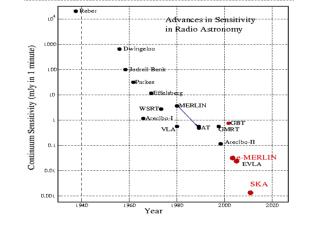
Studying the pristine IGM beyond the EOR: HI 21cm observations with the SKA and LOFAR SKA: A/T = 20000 m^2/K => nJy sensitivity at 1.4 GHz, mJy at 200 MHz Freq range = 0.1 to 20 GHz Resolution = 0.1” at 1.4GHz
Imaging the neutral IGM at z=8.5(Tozzi 2002) Galaxies: 6uJy at 2’ res (= 20 mK) tCDM and OCDM 30 Mpc comoving QSOs: 3uJy/beam at 2’ res With and without soft Xray pre-heating.
Difficulty with (LSS) emission observations: Confusion Continuum sources (di Matteo et al.2002) Free-Free emission (Oh & Mack 2002)
Cosmic Webafter reionization = Ly alpha forest (d <= 10) 1422+23 z=3.62 Womble 1996 N(HI) = 1e13 -- 1e15 cm^-2, f(HI/HII) = 1e-5 -- 1e-6 => Before reionization N(HI) =1e18 – 1e21 cm^-2
Cosmic Web before reionization: HI 21cm Forest Z=9 Z=7 Carilli, Gnedin, Owen 2002 Absorption – best done at (sub)arcsecond resolution => 1000 km baselines • Mean optical depth (z = 10) = 1% = ‘Radio Gunn-Peterson effect’ • Narrow lines (1 to 10%, few km/s) = HI 21cm forest (d = 10)
SKA observations of absorption before the EOR A/T =2000 m^2/K 240 hrs 1 kHz/channel z = 10 z = 8
Absorption in primordial disks toward GRBs/Starbursts? N/Dz << minihalos and IGM (<1e-4x) but t>> minihalos and IGM (>50x) => Use much fainter radio sources (0.1 mJy): GRB afterglow within disk? or Starburst radio emission? Furlanetto & Loeb 2002 t > 1
Luminous radio sources at very high z Radio galaxy: 0924-220 (van Breugel et al) z = 5.19 S_151 = 600 mJy Quasar: 0913+5821 (Momjian et al.) z = 5.12 S_151 = 150 mJy M_BH = 1e9 M_sun 10mas 1” • (sub)arcsec resolution preferred: decrease confusion, allow imaging
CO 3-2 at z=6.42 1148+5251 z=6.42 46.6 GHz VLA detection of CO 3-2 emission from most distant QSO – within the EoR (Walter, Carilli, Bertoldi) M(dust) = 1e8 M_sun M(H_2) = 2e10 M_sun M_BH = 1 – 5e9 M_sun M_dyn > 1e10 M_sun S_190MHz = 0.1 mJy predicted if dust is heated by star formation
Radio sources beyond the EOR: sifting problem (1/1400 per 20 sq.deg.) 1.4e5 at z > 6 S_120 > 6mJy 2240 at z > 6
Summary: SKA study of the EoR • ‘Complex’ reionization -- GP: F(HI) > 0.01 at z=6.4, CMB pol: F(HI) < 0.5 at z= 20. • Neutral IGM is opaque => need observations longward of 1mm • Neutral, pristine IGM: realm of low frequency radio astronomy. • HI 21cm emission probes large scale structure. • HI 21cm absorption probes intermediate to small scale structure (radio GP effect, ‘21cm forest’, minihalos, proto-disks) – (sub)arcsec resolution decreases confusion, allows imaging. • Constrain: z_reion, detailed structure formation, nature of first luminous sources, ionizing background, IGM heating and cooling. • LOFAR should provide first detections of the neutral IGM at z>6. • SKA will allow for detailed studies.
ISSC: SKA planning schedule • 2002 Design concept “white papers” • 2002 Director Appointed: Management plan with ISSC • 2003 Updated design concept “white papers” • 2003 “White papers” on possible locations • 2004 Updated “white papers” on locations • 2005 Choice of SKA location • 2005 Full Proposals for designs to ISSC • 2007 SKA “facility definition” (may merge designs) • 2010-12 SKA construction begins ? • 2015-17 SKA completed ?
ISAC Mandates: • Revise science case and requirements, involving larger community, and put in context of future capabilities at other wavelengths. Goal: new Taylor-Braun document by Aug. 2004. • Evaluate (w. EMT) proposed SKA designs and advise ISSC. Goal: final design and site choice by ISSC in 2007 • Current documentation: • Science with the Square Kilometer Array, R. Taylor & R. Braun, 1999 (www.skatelescope.org/ska_science.shtml) • Perspectives on Radio Astronomy: Science with Large Antenna Arrays, ed. M. van Haarlem, 1999 (ASTRON) • SKA memo series: Groningen (2002), Bologna (2002), and Berkeley(2001), science working group reports (www.skatelescope.org/ska_memos.shtml)
Discovery of the EOR(Becker et al. 2002) Fast reionization at z= 6.3 => opaque at l_obs < 1 mm
Lower limit to z_reio: GP Effect Fan et al. 2002 White et al. 2003 f(HI) > 0.01 at z = 6.3
Thompson scattering => polarization • Large scale structure (10’s deg) => relic of EOR • t = Ln_es_e = 0.17 => z_reion = 10 to 20(Kogut et al. 2003) f(HI) < 0.5 at z = 20 Kogut et al. WMAP f(HI) > 0.01 at z = 6.3
IGM Thermal History: Spin, CMB, Kinetic and the 21cm signal Tozzi 2002 T_s T_CMB T_K • Initially T_S= T_CMB • T_S couples to T_K via Lya scattering • T_K = 0.026 (1+z)^2 (wo. heating) • T_CMB = 2.73 (1+z) • T_S = T_CMB => no signal • T_S = T_K < T_CMB => Absorption against CMB • T_S > T_CMB => Emission
Confusion by free-free emission during EOR (Oh & Mack 2003)
Detection limits Running rms: S_120 > 6 mJy in 240 hrs KS of noise: S_120 > 12mJy
Absorption by minihalos (d > 100)(Furlanetto & Loeb 2002) N/Dz(minihalos) = N/Dz(IGM) = 10/unit z at z=8, t > 0.02
Inverse Compton losses off the CMB = U_B (radio lobe)
CDM structure formation (PS) Efstathiou 1995 M_BH = 0.006 M_spheroid N(1e11, z=6 – 8) = 3/arcmin^2
Evolution of space density of luminous QSOs (Fan et al. 2003)
USS samples (de Breuck et al.) z>8 radio galaxies?



![SKA-Japan Industry Forum [SKA-Japan Workshop 2010]](https://cdn1.slideserve.com/3503304/ska-japan-industry-forum-ska-japan-workshop-2010-dt.jpg)