Complex Ions
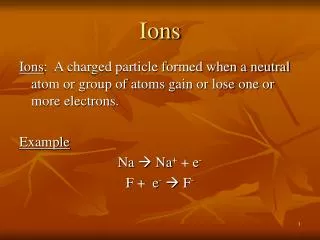
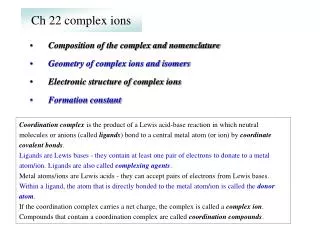
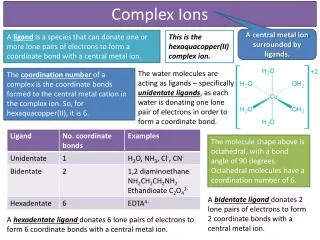
Complex ions are formed when positively charged central metal ions coordinate with several ligands, which can be anions or neutral molecules. The central metal is usually a transition metal, such as Cu²⁺ or Ni²⁺. Ligands can be unidentate, bidentate, or polydentate, influencing the coordination number and geometric structure of the complex. Naming conventions are systematic, prioritizing cations over anions and ligands are named before the metal. Understanding the bonding (coordinate covalent bonds) and geometric isomers helps to grasp the complexity of these compounds in coordination chemistry.

Complex Ions
E N D
Presentation Transcript
Complex Ion • An ion formed when a positive central element binds with multiple ions or polar molecules
Complex Ion • The central element is almost always a positively charged metal
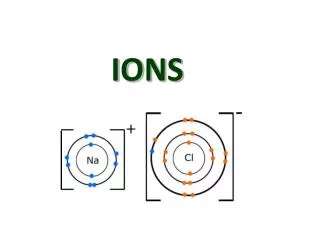
Anion • Negatively charged ion
Cation • Positively charged ion
Metal Ion Examples • Cu+2 Cu+ Au+ • Ag+ Zn+2 Ni+2 • Pt+2 Co+2 Al+3
Ligands • The negative ions or polar molecules bound by the central element in a complex ion
Ligand Examples • Cl- F- H2O • NH3 CN- Br- • NO O2 OH-
Polydentate Ligands • Ligands that can bind to more than one point
Bidentate Ligands • Ligands that can bind to two points in a complex ion
Bidentate Examples • H2N-CH2-CH2-NH2 • -O2C-CO2-
Tridentate Ligands • Ligands that can bind to three points in a complex ion
Tridentate Examples • H2-C-COO- • HO-C-COO- • H2-C-COO-
Chelates • Polydentate ligands that bind to metal ions in solution
Coordination Number • The number of points in which ligands bind to the central element in a complex ion
Coordinate Covalent Bond • Covalent bonds in which both electrons involved are donated by one atom
Complex Ions • The bonds formed in a complex ion are coordinate covalent bonds
Coordination Complex • A complex ion and its counter ion
Complex Ions • The bonds formed in a complex ion are coordinate covalent bonds
Complex Ion • Because of the type bonding, they are sometimes called coordinate complexes
Naming Complexes • 2) Name ligands before metal in the complex ion
2) Naming Ligands • a) give neutral compds normal names except:
H2O aqua • NH3 amine • CO carbonyl • NO nitrosyl
2) Naming Ligands • b) change -ide endings to -o for all anions
2) Naming Ligands • d) use geometric prefixes for monodentate ligands
2) Naming Ligands • e) use bis- for 2 & tris- for 3 polydentate ligands
3) Naming Metal • a) use the normal name if the complex ion is (+)
3) Naming Metal • b) make the metal ending -ate if the complex ion is (-)
3) Naming Metal • d) use Roman numerals in () to indicate metal ox #
Name the Following: • [Pt(NH3)4]Cl2 • [Co(H2O)2Cl4]-2 • [Cu(H2O)2(en)2]I2
Predict # of isomers of each: • [Pt(NH3)4 Cl2] [Co(H2O)3Cl3]
Complex Ion Shapes • 2-linear • 4-tetrahedral or sq pl • 6-octahedral
Geometric Isomers • Square planar vs tetrahedral • cis vs trans
Geometric Isomers • Bunched octa- • T-shaped octa- • bis: cis vs trans
Optical Isomers • Tri-bis mirror images
Field Strength • CN- > NO2- > en > NH3 > NCS- > H2O > F- > Cl-
Field Strength • CN- is strong field • Cl- is weak field
Field Strength • Determines d-level splitting or Do(splitting energy)
Field Strength • Large Do yields low spin or diamagnetic compds
Field Strength • Small Do yields high spin or paramagnetic compds
[Pt(NH3)2I4]-2 • Determine: • Name, shape, & possible isomerism
[Co(NH3)6]+3 yellow [Co(NH3)5NCS]+2 orange [Co(NH3)5H2O]+2 red [Co(NH3)5Cl]+2 purple t-[Co(NH3)4Cl2]+1 green
Complex Ion Equilibria Cu+2 + 4 NH3 [Cu(NH3)4]+2 [Cu(NH3)4]+2 [Cu+2][NH3]4 Kf =
Calculate the ratio of [Cu+2]/ [Cu(NH3)4]+2 when Cu+2 is added to a 0.10 M NH3 solution:Kf = 2.0 x 10¹²
Common Ion Equilibria • The larger the Kf, the more likely the complex will form
Common Ion Equilibria • Kf for [Ag(NH3)2]+1 • = 1.7 x 10⁷ • Kf for [Ag(CN)2]-1 • = 2.0 x 10²⁰
Common Ion Equilibria • Kf for [M(NH3)2]+2 • = 1.7 x 10⁷ • Kf for [M(CN)4]-2 • = 2.0 x 10²⁰
Common Ion Equilibria CN- will replace NH3 in the complex with silver