Understanding Speed and Acceleration in Motion Dynamics
This guide explores the key concepts of speed and acceleration, emphasizing their differences and real-world applications. We investigate how an object changes velocity, whether speeding up, slowing down, or turning, using examples like a toy car racing down a ramp. Key vocabulary includes acceleration, vector, and scalar quantities, along with the formula (a = Delta v / Delta t). Real-world connections illustrate the dynamics of motion on roads. Enhance your understanding of changing speeds and acceleration through practical problems and thorough explanations.

Understanding Speed and Acceleration in Motion Dynamics
E N D
Presentation Transcript
ESPN Sports Figures TRACKING SPEED: Speed vs. Acceleration
Investigate Recap • What happened to the cart as it rolled down the ramp? • Speed? • What happened to the cart as it rolled up the ramp? • Speed? • What can we say about an object that has a velocity that is changing?
Investigate #12b • Formula/equation for acceleration: a=Δv/Δt
Vocabulary • Acceleration – the change in velocity with respect to a change in time; “how fast the velocity changes; a = Δv/Δt; unit: m/s/s • Vector – a quantity that has both magnitude and direction • Scalar – a quantity that has magnitude (size/amount), but no direction
Vector vs. Scalar • Why not just use speed? • What does velocity mean? • How can you change velocity without changing speed?
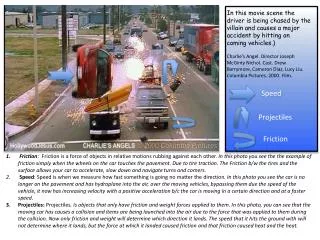
Changes in Velocity • Speed up (increase in speed) • Slow down (decrease in speed) • Turn (change the direction of the velocity) • What is happening in each of these situations?
Real World Connection Passing on a Two Lane Road • http://youtu.be/Duw-c8O8Y9Y
Vocabulary • Acceleration – the change in velocity with respect to a change in time; “how fast the velocity changes; a=Δv/Δt; unit: m/s/s • Vector – a quantity that has both magnitude and direction • Scalar – a quantity that has magnitude (size/amount), but no direction • Negative acceleration – a decrease in velocity with respect to time • Positive acceleration – an increase in velocity with respect to time
Describing Motion • What are the three ways to describe motion?
Describing Motion • What are the three ways to describe motion? Δv a Δt
Sample Problems • At the start of a race, a toy car increases speed from 5 m/s to 25.0 m/s as the clock runs from 0 s to 2.0 s. Find the acceleration of the toy car.
Vocabulary • Acceleration – the change in velocity with respect to a change in time; “how fast the velocity changes; a=Δv/Δt; unit: m/s/s • Vector – a quantity that has both magnitude and direction • Scalar – a quantity that has magnitude (size/amount), but no direction • Negative acceleration – a decrease in velocity with respect to time • Positive acceleration – an increase in velocity with respect to time • Tangent line – a straight line that touches a curve in only one point
Homework Complete Study Guide • Write down any questions so that you don’t forget when we return to class tomorrow