Download
1 / 9
90 likes | 214 Views
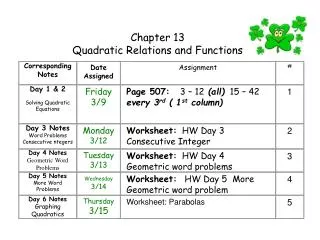
This week’s math curriculum focuses on solving quadratic equations and word problems involving consecutive integers and geometric conditions. Starting with foundational concepts on Friday, 3/9, students will engage in worksheets and class discussions through the week. Key activities include solving quadratic equations by factoring, exploring patterns in consecutive integers, and applying geometric reasoning to word problems. By the end of the week, students will understand quadratic relations and functions, and be able to solve practical problems using these mathematical principles.

E N D
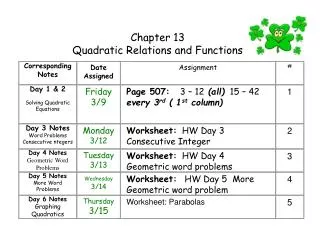
Corresponding Notes Date Assigned Assignment # Day 1 & 2 Solving Quadratic Equations Friday 3/9 Page 507: 3 – 12 (all) 15 – 42 every 3rd ( 1st column) 1 Day 3 Notes Word Problems Consecutive ntegers Monday 3/12 Worksheet: HW Day 3 Consecutive Integer 2 Day 4 Notes Geometric Word Problems Tuesday 3/13 Worksheet: HW Day 4 Geometric word problems 3 Day 5 Notes More Word Problems Wednesday 3/14 Worksheet: HW Day 5 More Geometric word problem 4 Day 6 Notes Graphing Quadratics Thursday 3/15 Worksheet: Parabolas 5 Chapter 13 Quadratic Relations and Functions
Warm up: Factor x2 – 10x + 21
Let x= integer, x + 1 , x +2 Let x= even, x + 2 , x +4 Let x= odd, x + 2 , x +4
EXAMPLES: • When the square of a certain number is diminished by 9 times the number the result is 36. Find the number. • 2. A certain number added to its square is 30. Find the number. x2 – 9x = 36 x2 – 9x – 36=0 (x – 12)(x + 3) = 0 x – 12 = 0 x + 3 = 0 x = 12 x = -3 x2 + x = 30 (x – 5)(x + 6) = 0 x2 + x – 30=0 x – 5 = 0 x + 6 = 0 x = 5 x = -6
The square of a number exceeds the number by 72. Find the number • 4. Find two positive numbers whose ratio is 2:3 and whose product is 600. x2 + x = 72 x2 + x – 72 = 0 (x – 8)(x + 9) = 0 x – 8 = 0 x + 9 = 0 x = 8 x = -9 6(x2 – 100 ) = 0 GCF 6(x + 10)(x – 10)=0 D2PS (2x)(3x) =600 Let 1st = 2x 2nd = 3x 6x2 = 600 6x2 – 600 = 0 x – 10 = 0 x + 10 = 0 x = 10 x = -10
The product of two consecutive odd integers is 99. Find the integers. • 6. Find two consecutive positive integers such that the square of the first is decreased by 17 equals 4 times the second. x(x + 2) = 99 (x – 9)(x + 11) = 0 Let 1st = x 2nd = x + 2 x2 + 2x = 99 x2 + 2x - 99 = 0 x – 9 = 0 x + 11 = 0 x = 9 x = -11 Solution: 9,11 or -9,-11 x2 - 17 = 4(x + 1) Let 1st = x 2nd = x + 1 x2 – 17 = 4x + 4 -4x -4x (x – 7)(x + 3) = 0 x2 – 4x - 17 = 4 x – 7 = 0 x + 3 = 0 -4 -4 x = 7 x = -3 x2 – 4x - 21 = 0
The ages of three family children can be expressed as consecutive integers. The square of the age of the youngest child is 4 more than eight times the age of the oldest child. Find the ages of the three children. • 8. Find three consecutive odd integers such that the square of the first increased the product of the other two is 224. x2 = 8(x + 2) + 4 Let youngest = x 2nd = x + 1 oldest = x + 2 x2 + (x + 2)(x + 4)= 224 Let 1st = x 2nd = x + 2 3rd = x + 4