MULTIvalued Dependency
This agenda covers the concept of Multivalued Dependencies (MVDs) in database relations. An MVD X>>Y holds if two tuples agreeing on attributes X can swap their Y components, resulting in valid tuples. Explore MVD rules, including how every functional dependency (FD) is also an MVD, and the complementation property. Through detailed examples, we will illustrate these concepts, such as with instructors, books, and prices. Understanding these dependencies is crucial for database normalization and integrity. Engage with practical examples and visual representations throughout the session.

MULTIvalued Dependency
E N D
Presentation Transcript
Denny Tran CS157B 3/25/2010 MULTIvalued Dependency
Agenda • Definition • MVD Rules • Examples
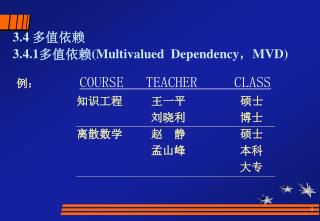
Definition • The multivalued dependency X->>Y holds in a relation R if wherever we have two tuples of R that agree in all the attributes of X, then we can swap their Y components and get two new tuples that are also in R.
MVD Rules Every FD is an MVD: If X -> Y, then X ->> Y A -> B 1: 3 2: 1 A ->> B
MVD Rules Cont Complementation: If X ->> Y, then X ->> Z where Z is all attributes not in X or Y. 1: 2,3 2: 2,1 Show if A ->> B then A ->> C True
Example 1 Instructor ->> Book Price: Intro Comp Parker: Intro Comp Kemp: Data in Action, ORACLE Tricks Warner: Data in Action, ORACLE Tricks ORACLE Tricks Data in Action ORACLE Tricks Data in Action MVD Satisfied!
Example 1 cont Instructor ->> Class Price: MIS2003 Parker: MIS2003 Kemp: MIS4533 Warner: MIS4533 Nothing to swap so satisfies MVD.
Example 1 cont Class ->> Instructor MIS2003: Price, Parker MIS4533: Kemp, Warner Parker Price Warner Kemp Warner Kemp MVD Satisfied!
Example 2 Name ->> Area Code? No Name ->> Phone? No
Example 2 Cont Name ->> AreaCode Phone? Yes! Sue: {650, 555-1111}, {415, 555-9999}
Example 3: Tuple-generating effect of MVD A ->> B 1: 1, 2, 3 1 2 2 1 1 3 2 1 1 1 3 1 1 3 3 1 1 1 1 2 1 2 1 2