Understanding Asphyxia Risks in Infant Sleeping Practices
This overview highlights the risks of asphyxia for infants during sleep, particularly in co-sleeping scenarios. Factors such as adult fatigue, substance influence, and the presence of siblings or pets can heighten these risks. Anatomical vulnerabilities include the infant's head and neck structure, which can lead to dangerous positions if they become wedged between surfaces or held under an adult's arm. Awareness of these risks is crucial for caregivers to ensure the safety of sleeping infants.

Understanding Asphyxia Risks in Infant Sleeping Practices
E N D
Presentation Transcript
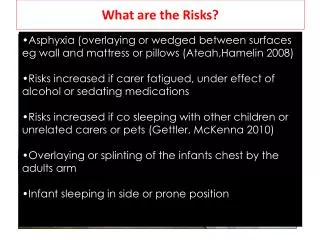
What are the Risks? • Asphyxia (overlaying or wedged between surfaces eg wall and mattress or pillows (Ateah,Hamelin 2008) • Risks increased if carer fatigued, under effect of alcohol or sedating medications • Risks increased if co sleeping with other children or unrelated carers or pets (Gettler, McKenna 2010) • Overlaying or splinting of the infants chest by the adults arm • Infant sleeping in side or prone position
Anatomical Factors • Anatomical factors-forward flexion of the infants head to chest/desaturation due to body limb against baby’s chin or sleeping with adults arm under its head or pillow(McIntosh, Tonkin,Gunn 2009) • “..weight of adult causes depressions in a bed where a baby may be forced into a flexed position..”
Newborn • Large heavy head • Short neck • Small lower face