Understanding Characterization: Depth and Dimensions in Storytelling
Explore the concept of characterization in storytelling, where writers create believable characters that enrich narratives. This resource defines key terms such as flat, round, static, and dynamic characters. It explains direct and indirect characterization methods and the role of foils in revealing distinct character traits. Through an engaging art film, learn what makes characters come alive and how their development impacts the story. Enhance your writing skills with practical exercises and deepen your understanding of character traits and their significance in storytelling.

Understanding Characterization: Depth and Dimensions in Storytelling
E N D
Presentation Transcript
Characters in Popular Culture • http://www.youtube.com/watch?v=XjVlyIvLg3Q • A quirky little art film. Watch what happens… • http://vimeo.com/6466874
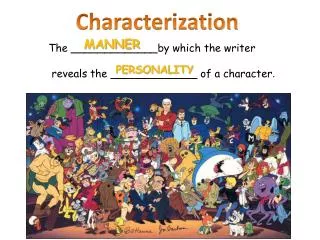
What is Characterization? • These are terms that apply to characterization, which is defined as: • the methods by which a writer creates people in a story so that they seem actually to exist. • These methods bring characters to life and thus give the story depth and texture
Flat Character • a one-dimensional character • embodies one or two qualities, ideas, or traits that can be easily described in a brief summary Round Character • a more fully-developed character • this character is complex, has more depth, and can be difficult to summarize
Static Character • a character who does not change during the course of the story Dynamic Character • a character who undergoes some kind of change because of the action of the plot
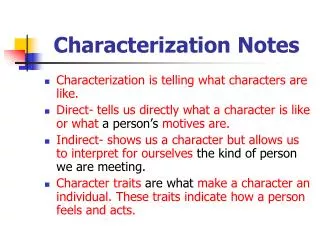
Direct Characterization • when the author directly states a character's traits Indirect Characterization • when an author tells us what a character looks like, does, and says and how other characters react to him or her. • It is up to the reader to draw conclusions about the character based on this indirect information
Foils • a character who acts by contrasting another character, revealing that character’s distinct qualities • Foils are not always polar opposites • Protagonist/antagonist • Good guy/bad guy • “Foil” is used in this light as a noun, not as a verb • A character does not “foil” another one, unless he or she “thwarts, hinders, or prevents” the second character in some way
Jack-A Character Study • http://vimeo.com/14728775 • Using your descriptive character word list, develop a list of ten character traits. • Write the word-then one or two sentences explaining why you chose that trait. • Ex: Disorganized-in the scene where he was searching for his cell phone-he had to look in many places in two separate rooms.