Download
1 / 20
200 likes | 320 Views
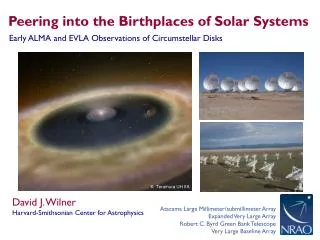
Early ALMA and EVLA Observations of Circumstellar Disks. Peering into the Birthplaces of Solar Systems. K. Teramura UH IfA. David J. Wilner. Atacama Large Millimeter/ submillimeter Array Expanded Very Large Array Robert C. Byrd Green Bank Telescope Very Large Baseline Array.

E N D
Early ALMA and EVLA Observations of Circumstellar Disks Peering into the Birthplaces of Solar Systems K. Teramura UH IfA David J. Wilner Atacama Large Millimeter/submillimeter Array Expanded Very Large Array Robert C. Byrd Green Bank Telescope Very Large Baseline Array Harvard-Smithsonian Center for Astrophysics
From Disks to Planets Silhouette Disks in Orion Nebula around ~1 Myr-old stars Planets Orbting HR8799 Astro2010: How do circumstellar disks evolve and form planetary systems? Marois et al. 2008, 2010 McCaughren & O’Dell 1995 AAAS, February 2012
Relevance of Radio Astronomy • avoid high dust opacities mass tracer • many spectral lines diagnostics, kinematics • sensitive to cold material including mid-plane • contrast with star planet-forming region • high sensitivity and angular resolution ALMA and EVLA! ALMA EVLA AAAS, February 2012
Next Generation Radio Telescopes Atacama Large Millimeter Array Expanded Very Large Array • 66 moveable 12m/7m antennas 5000 m site in northern Chile l= 300 mm to 3 mm • global collaboration (NA, EU, EA) to fund >$1B construction • 27 moveable 25 m antennas 2000 m site in New Mexico l= 7 mm to 4 m • modern electronics and signal processing, c. 1980 infrastructure 10-100x better sensitivity, spectral capabilities, resolution AAAS, February 2012
Some Early Disk Observations ALMA Science Verification: TW HyaProtoplanetary Disk test system validity, data released to community disks@EVLA key project: Grain Growth and Structure PI Claire Chandler (NRAO) and 17 co-I’s worldwide ALMA Early Science: Fomalhaut Debris Disk PI Aaron Boley (U. Florida) and 5 co-I’s • These results already showcase the extraordinary science potential of the new radio telescopes. • Many more amazing observations are underway. AAAS, February 2012
TW Hya Background • closest gas-rich ~few Myr-old disk (160 ly) • isolated, viewed nearly face-on • southern sky • many studies with Submillimeter Array HST, Weinberger et al. 2002 Doppler shift Andrews et al. 2011 Qi et al. 2004 AAAS, February 2012
TW Hya CO J=3-2 from ALMA Keplerian model/data comparison – can you tell the difference? • incredible data (from a small fraction of ALMA)! AAAS, February 2012
TW Hya DCN J=3-2 from ALMA imaging a deuterated, nitrogen-bearing, triatomic molecule (!) • Earth’s oceans are enriched in deuterium • deuteration is associated with low temps: • H3+ + HD H2D+ + H2 + DE • water delivery from cold, outer Solar System? (by comets) Hartogh et al. 2011 AAAS, February 2012
TW Hya DCN J=3-2 from ALMA SMA DCO+: D/H enhancement at large disk radii supports in situ deuteration at low T in outer disk • DCN distribution is different! Qi et al. 2008 Oberg et al. 2012 • water delivered from cold, outer Solar System? • evidence for multiple pathways to deuterium enhancement in disks AAAS, February 2012
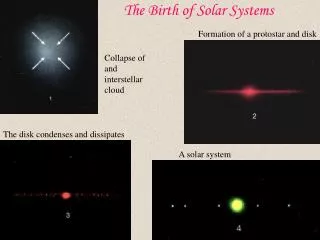
From Dust to Planets radio spectral signatures planet-disk interactions Planetesimal formation Planet formation Debris Gravity- assisted growth Gas capture Collisionalagglomoration ??? (collective effects) Collisons 1mm 1mm 1m 1km 1000km <1km AAAS, February 2012
Spectral Signatures of Grain Growth mm/cm dust emissivity ~ l- b is diagnostic of maximum grain size previous VLA results b 0 2 “pebbles” ISM grains see Draine 2006 b Rodmann et al. 2006 AAAS, February 2012
Disks@EVLA Key Project (PI Chandler) grain growth and substructure in protoplanetary disks: last observable link in chain from ISM to planets photometry of 60+ disks at 7/9/13/50 mm spectral indices reveal large grains reduction and modeling underway imaging of subsets, to 50 mas = few AU surface densities, disk-planet interactions observations ongoing expect resolved mm/cm colors K. Teramura UH IfA AAAS, February 2012
(Preliminary) EVLA Taurus Disk Images Chandler et al, in prep l = 9 mm (30.5 and 37.5 GHz) θ~ 0.7 arcsec = 100 AU spectral indices AAAS, February 2012
TW Hya: Planet-Disk Interaction • giant planet opens disk gap and creates cavity • 4 AU radius cavity (barely) detected with VLA Hughes et al. 2007 P. Armitage: jila.coloarado.edu/~pja AAAS, February 2012
TW Hya: Planet-Disk Interaction • should be easy to detect with EVLA and ALMA at the limits of ALMA Wolf & D’Angelo 2005 AAAS, February 2012
Fomalhaut Background ~200 Myr-old nearby star (25 ly) with dusty debris • directly imaged orbiting planet possible circumplanetary disk? Kalas et al. (2008) AAAS, February 2012
Fomalhaut with ALMA at 870 mm ALMA Cycle 0 Reference Image rms noise 70 mJy PI Boley: measure thermal dust emission from known circumstellar material and potentially circumplanetary dust near Fomalhautb using the compact (3 hrs) and extended early science antenna configurations 1.5” x 1.2” Boley et al. in prep. 20 arcseconds ~ 150 AU AAAS, February 2012 Kalas et al. (2009)
Underway inALMA Cycle 0… young disks: Orion, brown dwarfs, binaries, chemistry, gas/dust structure, dynamics PIs: Mann, Akeson, Ricci, Qi, Lin, Carpenter, Salyk, Chapillon, Walsh old disks: debris, birth rings, Herschel cold disks PIs: Rodriguez, Jordan, Carpenter, Boley, Wilner, Woitke in-between disks: gas-poor/dust-rich, gas-rich/dust-poor, gas in cavities, dust in cavities, unusually small/large disks PIs: Dutrey, Andrews, Chapillon, Casassus, van Dishoek, Perez, Schreiber, Kospal disks and planets: interactions PIs: Jordan, Huelamo, Boley AAAS, February 2012
A new “Radio Era” for Disk Studies • large samples of planet-forming disks now within reach • major unknown is distribution/evolution of cold dust and gas at Solar System scales:key observables for ALMA and EVLA • amazingprospects • expect surprises! at the limits of ALMA AAAS, February 2012