Download

1 / 23
240 likes | 379 Views
This guide delves into the principles of double replacement reactions, also known as double displacement or precipitation reactions. It covers the identification of these reactions, determining when they occur based on product solubility, and recognizing insoluble salts. The document provides various chemical equations including examples of what constitutes double replacement reactions. Additionally, it discusses complete ionic equations, net ionic equations, and the significance of spectator ions in chemical reactions. Test your knowledge by assessing different chemical reactions and their outcomes.

E N D
A double replacement is also called a • Double displacement reaction • Precipitation reaction • Non redox reaction • All of the above
Which of the following is a double replacement reaction? • 2Al + 3H2SO4 Al2(SO4)3 + 3H2 • Na2SO4 + 2AgNO3Ag2SO4 + 2NaNO3 • 3C + Fe2O3 2Fe + 3CO • C3H8 + 5O2 3CO2 + 4H2O
A double replacement reaction will occur if • All the products are soluble • One of the products formed is NaCl • One of the products is insoluble • One of the products is NaOH
Which of the following is insoluble? • NaSO4 • KSO4 • FeSO4 • PbSO4
Which of the following is insoluble? • SrBr2 • Sr(C2H3O2)2 • SrCO3 • SrCl2
Which of the following is insoluble? • PbCl2 • SrCl2 • CaCl2 • BaCl2
Which of the following would be insoluble? • NaCl • KBr • CaNO3 • BaSO4
Which of the following is insoluble? • FeS • CaClO3 • FeSO4 • NaNO3
Which of the following is insoluble? • FeS • CaClO3 • FeSO4 • NaNO3
KCl + Hg(NO3)2 • KNO3 + HgCl2 • KNO3 + HgCl • KNO3 + H2O + Hg • KHg + NO3(OH)2 • Not listed
Based on these products will the reaction occur between KCl + Hg(NO3)2 ? • Yes • No
KCl + Hg(NO3)2 What would be the precipitate if any? • KNO3 • HgCl • HgCl2 • KHg • Not listed
KCl + Hg(NO3)2 What would be one of the ions in solution after the reaction? • Cl- • Hg2+ • NO3+ • K2+ • Not listed
To make Fe(OH)3, one of the reactants could be • LiOH • Mg(OH)2 • FeOH • CaSO4 • Not listed
To make Fe(OH)3, possible reactants are • Fe(C2H3O2)3 • Fe(ClO3)3 • Fe(NO3)3 • All the above • Not listed
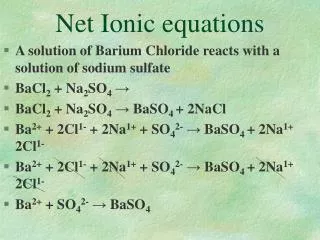
The complete ionic equation shows: • All reactants as ions • All aqueous compounds as ions • Aqueous products as solid compounds • Solid or liquid products as compounds • 1,2 and 4 only
The complete ionic equation shows: • All reactants as ions • All aqueous compounds as ions • Aqueous products as solid compounds • Solid or liquid products as compounds • 1,2 and 4 only
The ions that appear exactly the same on both the reactant side and product side are known as: • Repeater ions • Ionators • Spectator ions • Spectacular ions • Special ions
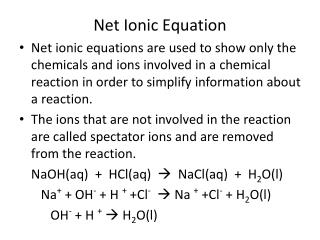
The net ionic equation is: • A balanced chemical equation • A reaction that defines the solid or liquid product • A display of all the ions in a reaction • 2 answers are correct
The net ionic equation for the reaction NH4OH (aq) + H2CO3 (aq) : • NH4+(aq) + CO32-(aq) (NH4)2CO3 (S) • OH-(aq) + H+(aq) H2O (l) • NH4+(aq) + H+(aq) NH5 2+(S) • 4. None of the above 0 of 30
The net ionic equation for the reaction Cu(ClO3)2 (aq) + Li2S (aq) : • Cu2+(aq) + S2- (aq) CuS (S) • ClO3-(aq) + Li+(aq) LiClO3 (S) • Cu2+(aq) + ClO3-(aq) Cu(ClO3)2 (S) • 4. None of the above 0 of 30
The net ionic equation for the reaction RbNO3(aq) + K2SO4 (aq) : • K+(aq) + NO3- (aq) KNO3 (S) • Rb+(aq) + SO42-(aq) Rb2SO4 (S) • K+(aq) + SO42-(aq) K2SO4 (S) • 4. None of the above 0 of 30