Understanding Net Ionic Equations and Ionic Precipitation in Aqueous Solutions
This guide explores net ionic equations, focusing on ionic compounds dissolved in water. It explains how ionic interactions lead to precipitation and emphasizes the importance of identifying which ions are active in chemical reactions. The process begins with the dissociation of compounds like NaCl and AgNO3 in water, leading to net ionic equations that ignore spectator ions. The approach includes balanced and unbalanced examples, highlighting how to identify and cancel common ions to find the net equation. Practice problems are included for a comprehensive understanding.

Understanding Net Ionic Equations and Ionic Precipitation in Aqueous Solutions
E N D
Presentation Transcript
Net Ionic Equations mixing ionic compounds
Ionic interactions • When you dissolve 2 or more ionic compounds in water some parts of it may react together and precipitate out • Precipitate-solid falling out of solution • More times than not, most (if not all) of the ions do nothing • Net ionic equations are only concerned with the ions that do something
This goes back to ionic dissociation in water NaCl(s) + AgNO3(s)in water Na+(aq)+ Cl-(aq) + Ag+(aq) + NO3-(aq) Net ionic ignores everything that doesn’t do anything! AgCl(s) + Na+(aq)+ NO3-(aq) Ag+(aq) +Cl-(aq) AgCl(s) net ionic equation-- Here’s the trick, AgCl is insoluble
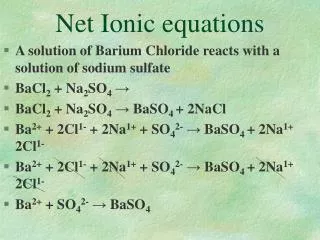
More net ionic equations • You normally write the reactants as aqueous (since you are dissolving them) • Mg(NO3)2(aq) + Na2CO3(aq) MgCO3(s) + 2NaNO3(aq) • Dissociate everything that is aqueous, not solid • Mg++ + 2NO3- + 2Na+ + CO3-- • MgCO3(s) + 2 Na+ + 2NO3- • Now cancel out everything that is the same on both sides of the equation • These are called spectator ions The remaining part is the net ionic equation Mg++ + CO3-- MgCO3(s)
What if nothing precipitates out? • K2SO4(aq)+AgNO3(aq) KNO3(aq) + Ag2SO4(aq) • (by the way, this equation isn’t balanced) • 2 K+ + SO42- + Ag+ + NO3- • K+ + NO3- + 2 Ag+ + SO42- • Everything cancels out • There is no net ionic equation
Practice with equations that are not yet balanced • K2CO3(aq)+ Ca(NO3)2(aq) • KNO3(aq) + CaCO3(s) • 2K+ + CO32- + Ca++ + 2 NO3- • CaCO3(s) +K+ + NO3- • Just ignore coefficients when canceling • Ca++ + CO32- CaCO3(s) • If it were unbalanced now you would balance it
Tip to make sure your answer is right • Make sure you have the same atoms on each side of the equation • If your final answer is something like • K+ + CO32- CaCO3(s) • It is wrong!!! • Atoms don’t spontaneously change into other atoms (without a nuclear reaction)
Homework • Na3PO4 (aq) + Ba(NO3)2 (aq) • NaNO3 (aq) + Ba3(PO4)2 (s)