Download
1 / 15
150 likes | 295 Views
This exploration details the evolution of funeral transportation, beginning with the origins of the word "hearse" and the first hearses used in the 17th century. It examines key changes in funeral vehicle designs through various eras, influenced by events like the Civil War. The discussion covers horse-drawn hearses, the introduction of gasoline-powered vehicles, and electric streetcars designed for funerals. Prominent innovations are highlighted, including Lincoln's funeral train and the emergence of specialized vehicles for floral transport and funeral directors.

E N D
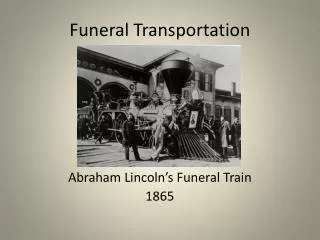
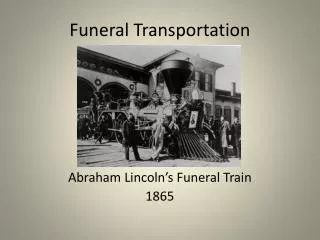
Funeral Transportation Abraham Lincoln’s Funeral Train 1865
Readings Question #1 • What are the French and Latin origins for the word hearse? Describe the first hearse.
Early Methods • bier (bear): “forerunner of today’s hearse; a hand stretcher on which the uncoffined body was carried to the grave” • horse-drawn carts: 1648 “hearse on wheels”
Colonial Hearses • wagon • horse-drawn hearses • “Gentleman’s Coaches” • “liverymen” • 1787: American funeral hearses • early pioneer: simple
Hearses with Horses1850 - 1910 • Readings Question #2: • What impact did the Civil War have on the style of hearses? • Readings Question #3: • Compare and contrast the hearse of the 1850’s with the hearse used during the Civil War.
Readings Question #4 • Compare and contrast the “funeral cars” of the following innovators: James Cunningham, Hudson Samson, and Crane & Breed.
Gas and Electric Vehicles • 1885: Baltimore- electric street railway Readings Question #5: Describe the first trolley funeral car. “a specially designed train car run on a city’s trolley line to transport casket and mourners to cemeteries on the outskirts of the city”
Gasoline-powered Hearses • Fred Hulberg: 1908 NYC • Crane and Breed Manufacturing Company: 1909 “auto-hearse”
Other Funeral Vehicles • Ambulance: 1909 • Undertaker’s Buggy: “vehicle used by undertakers to transport the necessary mortuary paraphernalia to the homes where funerals were typically held….had an appearance similar to a hearse, but were much less ornate” • Limousine: early 1920’s
Hearse Sizes and Colors • up to Civil War: black • after the war increase in length and width • children: white • larger funeral cars: darker colors • most popular: black • light-grey: carved hearses • World War I: black then grey
Cadillac Hearses 1930 1938
National Coach 1957
Transportation of Flowers • regular hearses equipped with special trays or receptacles • first flower cars: 7 passenger touring cars • emergence of vans and other converted vehicles
Readings Question #6 • How did the evolution of funeral transportation influence the responsibilities of the funeral director? Lincoln’s Funeral Procession