Interconnection vs. Interoperability: Navigating Telecom and Computing Interfaces
This exploration delves into the critical distinctions and intersections between interconnection in telecommunications and interoperability in computing. It addresses fundamental goals, standards setting, and the implications of these concepts on policy, regulation, and innovation. By mapping out key debates, this analysis highlights the trade-offs between integration and diversity, the roles of intellectual property, antitrust, and regulatory oversight, and the necessity for a balanced approach that serves public interest. The discourse culminates in assessing the future landscape of interface compatibility and strategic choices.

Interconnection vs. Interoperability: Navigating Telecom and Computing Interfaces
E N D
Presentation Transcript
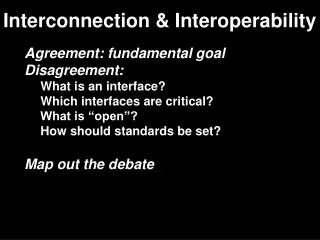
Interconnection & Interoperability • Agreement: fundamental goal • Disagreement: • What is an interface? • Which interfaces are critical? • What is “open”? • How should standards be set? • Map out the debate
3 fundamental problems • Clash of two concepts and of two debates: • Interconnection (telecom) • Interoperability (computing) • Economics / Strategy: • Technical merit • Strategic interest of the parties • Three policy domains: • IP protection • antitrust • regulatory oversight • Noclear separation, many conflicts
Interconnection v. Interoperability • Degree? Interop > Interconnect • Two distinct traditions: • Telecom Interconnection • Computing Interoperability • What are the relevant Interfaces? • What is the primary policy goal?
interface telecom interconnection computer interoperability appliance to network · physical: modular phone or CATV plugs · logical: standardsignaling ethernet (10baseT) appliance-to-application (not a major concern of traditional Telecom) Windows and Intel-based machines v. MacOS and Motorola-based machines application-to-application · interface between voice-mail systems service provider to carrier interface (ONA's BSAs/BSEs as the network's APIs) · file exchange between applications · message passing among different e-mail services · client/server compatibility · APIs: OS to application interface network-to-network MCI to PacBell, voice call [equal access] · internet [TCP/IP]
Primary policy goal? • Interconnection / Telecom: network effects, pursued through regulation • Interoperability/ Computing: encourage innovation, pursued through IP protection • Reflects inherent trade-off between integration and diversity
Policy trade-off integration diversity
Policy trade-off (monopoly) integration diversity (competition)
Policy trade-off (monopoly) integration diversity (competition)
Policy trade-off Ideal (monopoly) integration diversity (competition)
Policy trade-off Ideal (monopoly) integration Virtual integration diversity (competition)
Policy trade-off Ideal Virtual differentiation (monopoly) integration Virtual integration diversity (competition)
Policy trade-off Telecom integration (Regulated Interconnection) Computing diversity (IP protection& competition)
Policy trade-off Ideal Virtual differentiation integration Virtual integration diversity
Interfaces and Strategy • which interfaces are critical? • what is “open”? • Fully open • Fully Closed • Most lie in between • what is “proprietary”? • how should interface standards be set? • government mandate • Voluntary consensus • Market competition
Compatibility & interconnection Users Producers with locked-in, quasi-monopoly position (Microsoft, IBM, CATV)
Compatibility & interconnection Common carriers Suppliers without monopoly position Users Producers with locked-in, quasi-monopoly position (Microsoft, IBM, CATV)
Interfaces and Policy • Primary concern: • Telecom: encourage network effects. Regulatory oversight. Ex-ante (introduce competition within monopolies) • Computing: encourage innovation IP protection. Ex-Post (grant IP protection -- monopoly -- remedies if abuses
Interfaces and Policy (cont'd) • Intellectual Property: temporary monopoly • Copyright • Patents • Trends? • - Toward denying IP protection for interfaces • - Increasing use of patent protection for software (as functional) • Antitrust • Counterweight to IP • "Essential Facilities" • Blunt instrument • Regulatory oversight
Conclusion • Should we care? • Will private incentives serve the public interest? • Is there scope for beneficial government action?
Conclusion • Should we care? YES • Will private incentives serve the public interest? • Is there scope for beneficial government action?
Conclusion • Should we care? YES • Will private incentives serve the public interest?NO • Is there scope for beneficial government action?
Conclusion • Should we care? YES • Will private incentives serve the public interest?NO • Is there scope for beneficial government action?MAYBE…