Understanding Teams and Teamwork in Organizational Workgroups
This module explores the significance of teams and teamwork within organizational settings. It defines what constitutes a group and differentiates various team types, such as problem-solving, creative, tactical, and ad hoc teams. Key principles of effective teamwork are discussed, including member feedback, interdependence, and leadership. The interpersonal processes of communication, conflict management, cohesion, and trust are analyzed, along with the importance of personnel selection and training for team efficiency. Learn how to optimize team dynamics for enhanced performance.

Understanding Teams and Teamwork in Organizational Workgroups
E N D
Presentation Transcript
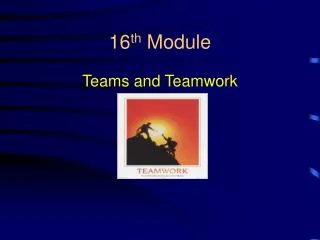
16th Module Teams and Teamwork
Organizational Workgroups • Trend toward using workgroups, teams, committees, etc. • What defines a group? • 2 or more people • Common goal or task • Recognized membership • Interdependence
Level of Analysis Organization (macro) Team Individual (micro)
Types of Teams • Problem Solving Teams – Members assemble to solve a particular problem • Must resolve problem to most people’s satisfaction, not own • Creative Teams – Assembled to come up with new ideas • Brainstorming for new products ideas, marketing, etc. • Tactical Teams – Assemble to execute a plan • Members have clearly defined roles (ex: SWAT teams) • Ad hoc Teams– Assembled for a limited time to solve a specific problem • Cross between a problem-resolution and a tactical team
Principles of Effective Teamwork • Members provide and accept feedback • Should be constructive and flow up as well as down • ex: catcher suggests to pitcher which pitch to throw • Members must be willing & prepared to back up others • Know when to jump in and help • ex: pitcher’s job doesn’t end with the pitch • Members view themselves as a group • Success of team more important than individual • ex: sacrifice bunt • Members are interdependent • Rely on one another to carry out mission • ex: everyone must make their plays • Team leadership is important • Leaders don’t just instruct, they serve as role models and influence team member behavior • ex: team captain leads by example and influence
Team Processes • Socialization – process of mutual adjustment between the team and its members • Based on evaluation, commitment & role transition • Socialization passes through 5 phases: 1. Investigation: team and individuals find a good match 2. Socialization: individuals and team assimilate to each other 3. Maintenance: both parties try to maximize their needs 4. Resocialization: team and individual try to influence each other in order to satisfy team needs 5. Remembrance (Advisory): occurs if resocialization is not successful
Interpersonal Processes in Teams 1.Communication • Ideal communication is frank, continuous, & regular 2. Conflict • unavoidable in teams; what is important is how teams deal with conflict • conflict can be seen as beneficial (different ideas but willing to listen) or competitive ( disagree with team members, not willing to listen to other’s opinion) 3. Cohesion • team members feel attracted to their team and want to stay in it 4. Trust • creates an environment where workers spend less time worrying about others and are more willing to allow other team members to help them
Personnel Selection for Teams • Successful selection of team members requires identifying the best mix of personnel for effective team performance • Prieto (1993) describes 5 critical social skills for an individual in a team to possess: 1. gain the group acceptance 2. increase group solidarity 3. be aware of the group consciousness 4. share the group identification 5. manage others’ impressions of him or her • Examining relationship between personality variables and team effectiveness • factors of conscientiousness & agreeableness have been found to predict various dimensions of work team performance • Stevens and Campion (1999) developed test to measure team related KSAs • e.g., conflict resolution, collaborative problem solving, communication, & planning
Training for Teams • A team task analysis is conducted to assess tasks that require coordination • Subject Matter Experts (SMEs) are asked to provide info on each task that requires interdependency • Info obtained is used to specify team training objectives • Salas and Cannon-Bowers refer to team KSAs as: thinking, doing, & feeling • Much of our knowledge on team training comes from military applications • e.g., cross-training - exposure to and practice on other teammates’ tasks, results in increased knowledge regarding task responsibilities and coordination requirements
The Structure of team trainingSalas & Cannon-Bowers, 1997 Team Performance Cognition Behaviors Attitudes Knowledge Skills Affect “Think” “Do” “Feel”