IMPERIALISM
110 likes | 223 Views
The period of New Imperialism, marked by the unification of Germany and Italy, saw major industrial powers like England, Germany, and France expanding their territories. This expansion was driven by economic motives for resource acquisition, military aspirations, and a sense of nationalism. The concept of the "White Man's Burden" was propagated to justify imperialism, suggesting intervention was for the betterment of colonized peoples. The Scramble for Africa, epitomized by the Berlin Conference, disregarded African cultures and boundaries, leading to lasting challenges in the 20th century.


IMPERIALISM
E N D
Presentation Transcript
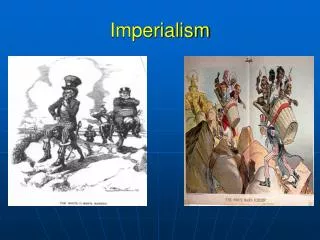
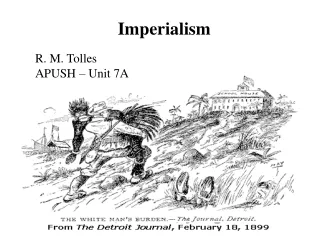
NEW IMPERIALISM:One area or country controls another’s P.E.R.S.I.A. • Following unification of Germany and Italy, Industrial Powers (England, Germany, France) began to acquire new territory. • WHY? 1. Economics (Acquire Resources for industry) 2. Military 3. Nationalism 4. White Man’s Burden. “For their own good”
White Man’s Burden—Rudyard Kipling Take up the White Man's burden--Send forth the best ye breed--Go bind your sons to exileTo serve your captives' need;To wait in heavy harness,On fluttered folk and wild--Your new-caught, sullen peoples,Half-devil and half-child.
Rudyard Kipling, “The Jungle Books” • The Jungle Book, “I want to be like you” • Riki Tiki Tavi
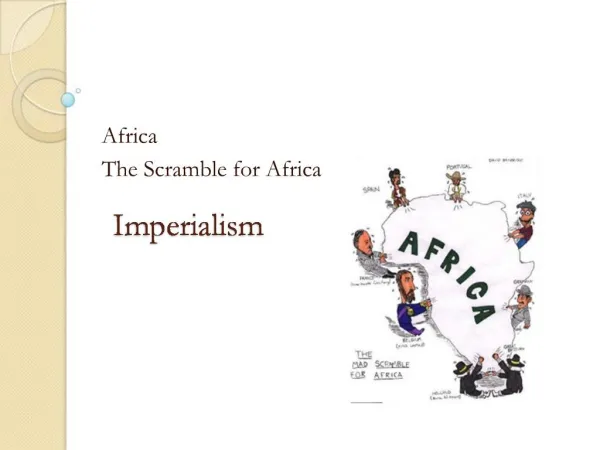
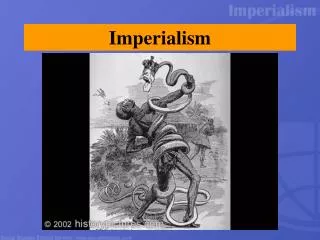
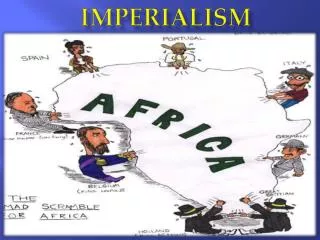
SCRAMBLE FOR AFRICA (1870) • Berlin Conference** • King Leopold (Belgium) sends a mission to imperializeThe Congo. Sets off a “scramble” • NO regard for African boundaries or culture. Leads to problems in 20th century.
Which two African States remained Free? Scramble for Africa Berlin Conference Page 638
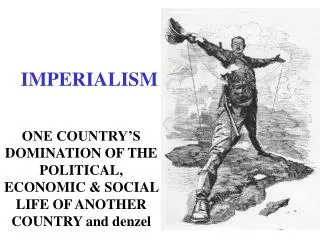
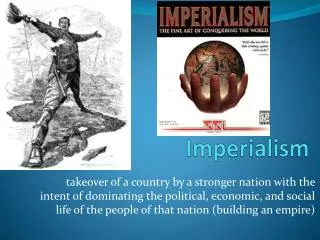
Colossus of Rhodes Cecil Rhodes, founder Of DeBeers Diamonds
England dominates the world in Imperialism. THE SUN NEVER SETS ON THE BRITISH EMPIRE