Download
1 / 13
130 likes | 240 Views
The House has passed a significant health care reform bill late Saturday night with a narrow 220-215 vote. This legislation aims to extend coverage to 36 million uninsured Americans and significantly expand Medicaid eligibility up to 150% of the federal poverty level. It introduces a government health care option, mandates rate negotiations between hospitals and insurers, and imposes fines on individuals who do not obtain insurance. However, concerns remain over the bill's impact on existing programs, tax increases, and potential job losses associated with the mandate.

E N D
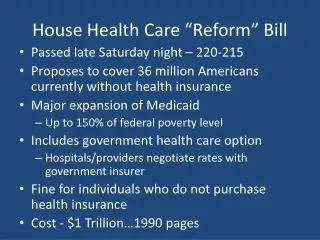
House Health Care “Reform” Bill • Passed late Saturday night – 220-215 • Proposes to cover 36 million Americans currently without health insurance • Major expansion of Medicaid • Up to 150% of federal poverty level • Includes government health care option • Hospitals/providers negotiate rates with government insurer • Fine for individuals who do not purchase health insurance • Cost - $1 Trillion…1990 pages
House Health Care Reform Bill • Private insurers cannot deny/drop coverage • Increased income tax on those making more than $500,000 • Medicare expenditures cut by 1.3% • $15 billion falls on prescription drug industry • 2.5% tax on medical device manufacturers • “Medicine Cabinet Tax” on HSAs • Stupak Amendment • Prevents federal funding for plans that cover abortion
Concerns • Medicaid broken! • Why expand a program all agree is broken? • States pick up almost half the tab and it is required • This will force other programs to take a hit OR • Tax increases to fund the status quo • This has not worked in TN, MA…why do it?
Concerns • More people will move to government health care and thus COST-SHIFT • HSAs are weakened by this legislation • Medicare benefits are cut/Medicare Advantage undercut • Still leaves almost half of the uninsured untouched • Fines for those who do not insure
Concerns • Can we afford this 1,000,000,000,000.00? • Will mandates grow jobs? • When will these new programs be passed along to the states? • How many new government jobs are required to carry out this mandate? • How much will be spent before the first person is helped? • Tort Reform?
Other Ideas • 1996 Welfare Reform • Let states use existing dollars to come up with own plan • Give national government true cost control • Flexible on many fronts • Proven model • Allow states to be empowered • Removes mandates
Other Ideas • Help move people on margins from Medicaid to private • Instead of being on government program they move to their companies HMO/PPO • Allow people to purchase health insurance across state lines • Give tax credits to the individual instead of the company
Other Ideas • HSAs better than no insurance especially for the “invinceables” • Put cost of medical services on the wall • Barebones coverage instead of required mandates • More aggressive anti-fraud measures
Interest Groups • Insurance Companies • Hospitals • Doctors • Patients • Small Business Owners
Interest Groups • Insurance • Lose patients when they go to Medicare • Baby Boomers • Like • Required coverage means more patients to insure • Dislike • Public plans lure away customers • Regulation means higher prices • Tax “Cadillac” plans…
Interest Groups • Hospitals • Hurt by low Medicaid reimbursement • Lack of EMR • Like • EMR • Coverage for uninsured helps cut “charity care” • Stop doctors from ownership of hospitals • Dislike • Lower reimbursements for Medicare
Interest Groups • Doctors • Face high malpractice rates “defensive medicine” • Low reimbursement rates and lack of primary care • Likes • Loan forgiveness for primary care • Medical home compensation • Dislikes • Lower reimbursements • Less acute care means less business
Interest Groups • Small Business • More are dropping coverage due to increased cost • Likes • Buy into larger risk pool • Could be exempt from new plan if small enough (10-25 employees) • Dislikes • Forced health benefits in weak economy • Higher prices or let employees go due to costs