Ionic and Molecular Compounds
This guide introduces ionic and molecular compounds, essential concepts in chemistry. A compound is defined as a pure substance formed from the combination of elements, represented by a chemical formula. Ionic compounds consist of a metal paired with a non-metal, where electrons are transferred, exemplified by NaCl. Conversely, molecular compounds are formed from non-metals, like H2O and CO2. This resource covers naming conventions for both types, including steps and examples for clarity. Perfect for students seeking to understand chemical bonding principles.

Ionic and Molecular Compounds
E N D
Presentation Transcript
Ionic and Molecular Compounds Science 9 – Matter and Chemical Change, Topic 6
What is a compound? • A pure substance • A combination of elements • A chemical formula tells you the types and numbers of atoms present. • Example: H2O has two hydrogen (H) and one oxygen (O) • 2 types: • Ionic compounds • Molecular compounds
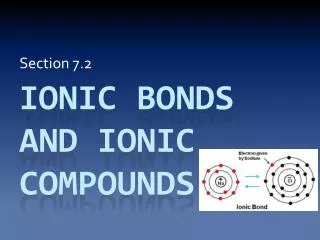
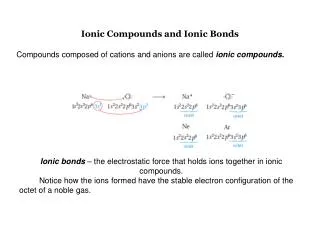
Ionic Compounds • A metal paired with a non-metal • Ex: NaCl • Electrons are transferred from the metal to the non-metal. • Na e- Cl • ____________ becomes more positive and ____________ becomes more negative.
Ionic Compounds • Metals: • Alkali metals like to transfer 1 electron • Alkaline earth metals like to transfer 2 electrons • Non-metals • Halogens like to receive 1 electron • OH likes to receive 1 electron • SO4 likes to receive 2 electrons • NO3 likes to receive 1 electron
Ionic Compounds • Example: Copper likes to give away 2 electrons. How many chlorine atoms will be able to bond to copper? (remember, each chlorine atom receives 1 electron) • Answer: • 2 chlorine • CuCl2
Ionic Compounds • Practice: • Li and F • Ca and Br • K and I • Ba and Cl • Cs and OH • Be and SO4 • Mg and OH
Do Now! April 3, 2011 • Combine the following elements into the correct chemical formula: • Calcium fluoride • Na and OH • Al (3+) and Cl
Molecular Compounds • A combination of non-metals • Ex: H2O, CO2, CCl4 • Some elements bind to themselves to form diatomic molecules • The diatomic molecules are: • H2, O2, N2
Naming Ionic compoundsex: ZnF • Step 1 • Write down the names of both elements • zinc fluorine • Step 2 • Change the ending of the 2nd element to –ide. • zinc fluoride • Special rules • oxygen oxide sulfur sulfide • nitrogen nitride carbon carbide • boron boride
Naming Molecular compoundsCF4 • Follow the steps for naming ionic compounds • carbon fluoride • And then… • Step 3 • Add a prefix to elements to indicate their number • 1= mono* 2=di 3=tri 4=tetra • *mono is only used for the 2nd element • carbon tetrafuloride
Naming Molecular Compounds • Practice • CO • CO2 • SiO2 • SO2 • BCl3