Download
1 / 4
40 likes | 166 Views
This study focuses on severe thunderstorms along the edge of Foz do Iguaçu, an area known for its frequent severe weather events. Conducted from November 2012 to January 2013, it utilizes data from AMSR-E and advanced dual-polarization Doppler radars to prepare for total lightning and analyze severe storm environments. The initiative includes deploying various instruments like disdrometers, micro-rain radar, and additional soundings to enhance understanding of storm dynamics. Future plans aim for a comprehensive analysis across Northern Argentina following the GOES-R launch.

E N D
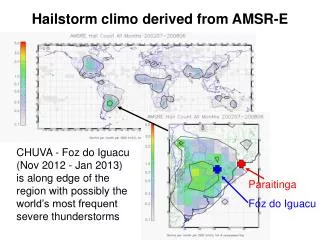
Hailstorm climo derived from AMSR-E CHUVA - Foz do Iguacu (Nov 2012 - Jan 2013) is along edge of the region with possibly the world’s most frequent severe thunderstorms Paraitinga Foz do Iguacu
Active Severe Tstm environment in MSG Seviri domain Dual-pol Doppler radars in the area for CHUVA Extra soundings, sites and # TBD Opportunity to prepare for total lightning + ABI-like data for svr tstms View angle from MSG at ~26 S, 56 E is similar to view angle of Northern Plains from GOES-East
CHUVA-Foz • Brazilians to deploy to Foz Do Iguacu in late 2012: • X-band dual-pol radar • 5-10 rain gauges • 4 disdrometers • 1 micro-rain radar • Additional upper-air soundings and ground instrumentation • S-band dual-pol likely in Cascavel (~120 km NE) • Several of us (Cecil, Nesbitt, Zipser, Houze, Salio, Machado, others) hope to augment the 2012 campaign: • Extra soundings • LMA • Extra radar • Then build toward a more comprehensive campaign in Northern Argentina after GOES-R launch