Download
1 / 7
80 likes | 216 Views
The human skeletal system consists of bones that serve as living tissues, providing structure, protection, and support to the body. Bones have a robust blood supply and are innervated, allowing for growth and regeneration. They also play a critical role in storing fat, assisting in the production of red blood cells in red marrow, and providing stability through various types of joints: immovable, slightly movable, and freely movable. Understanding the anatomy of these joints, like hinge, ball-and-socket, and gliding joints, highlights the skeletal system's fascinating complexity.

E N D
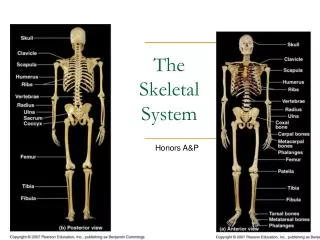
Bone as Living Tissue • Bones have a blood supply • Bones have nerves • Bones store and manufacture • Bones grow • Bone Marrow • Yellow Marrow • Storage of fat in long bone shafts • Red Marrow • Production of red blood cells in soft bone ends (cancellous)
Joints • Immovable Joints • Bones separated by a thin layer of connective tissue • Bones of the skull • Slightly Movable Joints • Gaps between bones are held together by cartilage • Vertebrae • Freely Movable Joints • Bones are separated by a cavity • Bones are held to other bones by ligaments • Tendons hold muscles to bones • Hinge joint - Knees and elbows • Ball and socket joint - Hip and shoulder • Gliding joint - wrist and ankles