Download
1 / 9
90 likes | 205 Views
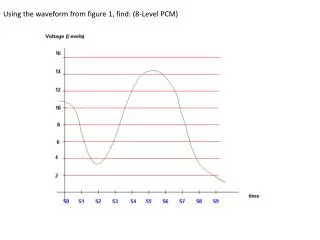
This guide explores 8-Level Pulse Code Modulation (PCM) using waveform analysis and odd parity transmission for data encoding. It includes the derivation of PCM codes, transmission streams with Frame Check Sequence (FCS), and calculations based on blocking code principles. The Hamming distances between various binary sequences are also determined. Additionally, you will learn how to visualize data using graph paper and PCM schemes, sampling voltages to produce new data streams along with updated FCS computations.

E N D
The PCM code and how many bits are needed to achieve a level of the code Write the stream to be transmitted using odd parity (sample at every Sn from S0 to S9)
Find a Frame Check Sequence (FCS), of 7 bits, and write the stream that is to be transmitted (select any P you desire and use modulo 2 arithmetic)
Within a blocking code principle system, if we wish to transmit blocks of data of length K=3 bits and with n=5, find: a) How many code words are possible? b) How many valid code words there are?
For the following binary sequences, d1, d2, d3, d4, calculate the hamming distances Vd1,d2; Vd1,d3; Vd1,d4; Vd2,d3; Vd2,d4; Vd3,d4. d1= 010110 d2 = 001101 d3 = 101111 d4 = 000110
The Bit Stream obtained in the last question of the previous tutorial (Tut05) contains data and FCS. Find the FCS used if the sequence used for coding it was: 1000111 Last Weeks Stream: 0011 0111 1110 0001 0010 1100
Plot (using graph paper) the data using an 8-level PCM scheme with a sampling interval of 1msec and a voltage equivalent of 2 volts per level. (locate your first sample at t=0ms and In the middle of the voltage point in the relevant range.
Sampling 7 times, obtain a new data stream from the graph obtained in the previous Question sampling every 0.5 ms (first sample should start where the signal starts – if a sample Is in the middle of two levels, take the lower level.
Find a new FCS for the data obtained in the previous problem using P=100101