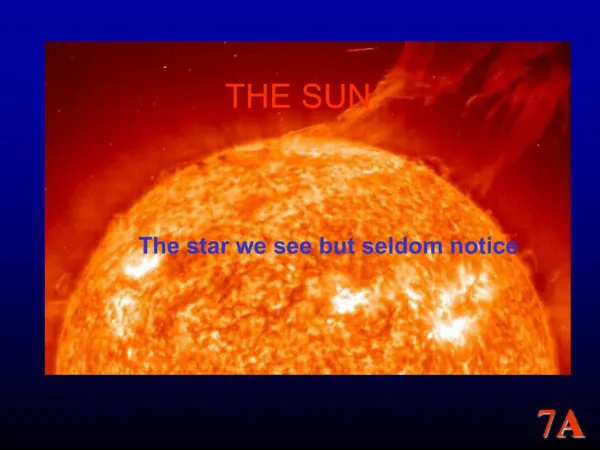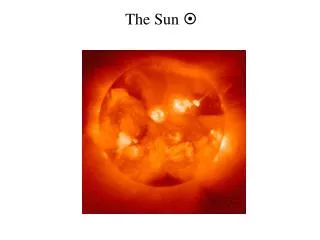
THE SUN
This text explores the intricate relationship between the Sun's energy, Earth's atmosphere, and climate. It highlights how the unique composition of Earth's atmosphere allows for the perfect absorption of sunlight needed for life while also addressing the risks of pollution thickening the atmosphere like that of Venus. Additionally, it delves into the mechanisms of heat transfer including conduction, convection, and radiation. The text also describes global wind patterns, such as trade winds, prevailing westerlies, and seasonal monsoons, and their impact on our weather systems.


THE SUN
E N D
Presentation Transcript
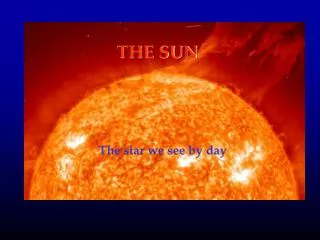
Whereitallstarts. THE SUN
Mars – toothin, so itdoesn´tabsorbenoughheat • Venus – so dense, theheatdoesn´t escape! • Earth – theperfectcombination!!! • Some of thesun´senergyis absorbed bytheatmostphere • Someis absorbed bytheplanet´sland and water • Someisreflected back intospace • Ifwekeeppollutingouratmospherecouldbecomethick and dense likeVenus´satmosphere!!! Ouratmosphereallowsourplanettoabsorbtheperfectamount of sunlightneededforlife
Radiation • Electromagneticwaves (thesun´sheatarrives) • Conduction • Directcontact (air touchingwarmland) • Convection • Movement in gases & liquids • Heatalwaysrisesbecauseitislighter/less dense • Whatdoesthismotioncreate? • Themotion of wind and oceancurrents!!!! Howisthermalenergytransferred?
Temperaturedifferences are causedbytheEarth´scurvedsurface Theequatorgets a lot more heatthanthe North and South poles (obvio) ThemotionisalsoaffectedbytheEarth´srotation Movement of air
Tradewinds - Neartheequatorallthewindblowswest and towardtheequator. • Prevailingwesterlies • Oneitherside of thetradewinds, theprevailingwesterliesblowopposite. • Alwaysblowtotheeast (fromthewest) • Alwaysblowawayfromtheequator • Polar easterlies- Polar windsalwaysblowingwest (fromtheeast) and towardstheequator (awayfromthe pole) • See page 352 in textbook Windsystems: Surfacewinds
Jet streamsfollowtheprevailingwesterlies at theirnorth and southborder • Jet streamsaveragebetween 97-185 km/hr • Justlikesailorshaveusedsurfacewindstosailtheirboats, pilots use jet streams • Ifthey are goingeast, theysavegasolinebygoing in the jet stream. • Ifthey are goingwesttheyavoidthe jet streams. Highaltitudewinds: jet streams
Landheats and coolsfasterthanwater!!!! • Duringtheday air abovethelandisheatedbyconduction • Theheated air… • Rises!!!! • So at thebeach in theday, thereis a currentfromthecool sea air going up. • At nightthe air abovelandiscooler • So at thebeach at night, thereis a currentgoingdowntowardsthewater. Dailywinds
Duringthewinter, thelandismuchcolderthantheocean, so likethebeach at night, the air movesawayfromtheland. Duringthesummer, thelandismuchwarmer so thewindblows in fromthe sea. Thiswindisusually full of moisture and brings a lot of rain. Seasonalwinds: monsoon