Download
1 / 1
10 likes | 139 Views
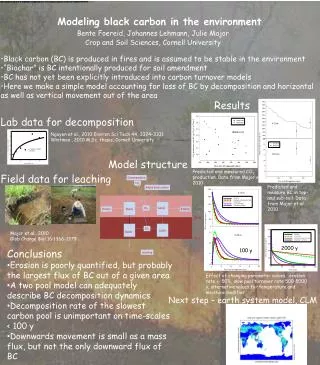
This study explores the temperature sensitivity of black carbon (BC) decomposition and oxidation, emphasizing its role in soil amendments as biochar. It investigates the fate of soil-applied BC, focusing on its downward migration, leaching, and respiration dynamics, using a two-pool model to describe BC decomposition. Results indicate that erosion may be the largest flux of BC from an area, while the slowest carbon pool’s decomposition rate is less significant over short time scales. The study highlights the importance of better quantifying BC dynamics in carbon turnover models.

E N D
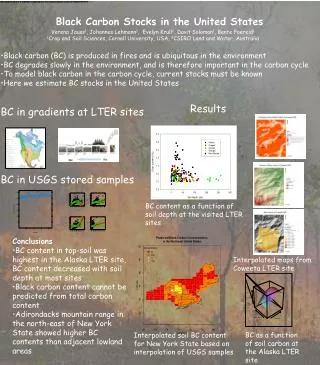
Nguyen B, Lehmann J, Hockaday WC, Joseph S, Masiello CA (2010) Temperature sensitivity of black carbon decomposition and oxidation. Environ Sci Tech DOI: 10.1021/es903016y Major J, Lehmann J, Rondon M, Goodale C (2010a) Fate of soil-applied black carbon: downward migration, leaching and soil respiration. Glob Change Biol 16:1366-1379 Major J, Lehmann J, Rondon M, Goodale C (2010a) Fate of soil-applied black carbon: downward migration, leaching and soil respiration. Glob Change Biol 16:1366-1379 Major J, Lehmann J, Rondon M, Goodale C (2010a) Fate of soil-applied black carbon: downward migration, leaching and soil respiration. Glob Change Biol 16:1366-1379 Major J, Lehmann J, Rondon M, Goodale C (2010a) Fate of soil-applied black carbon: downward migration, leaching and soil respiration. Glob Change Biol 16:1366-1379 Major J, Lehmann J, Rondon M, Goodale C (2010a) Fate of soil-applied black carbon: downward migration, leaching and soil respiration. Glob Change Biol 16:1366-1379 • Black carbon (BC) is produced in fires and is assumed to be stable in the environment • “Biochar” is BC intentionally produced for soil amendment • BC has not yet been explicitly introduced into carbon turnover models • Here we make a simple model accounting for loss of BC by decomposition and horizontal as well as vertical movement out of the area Results Modeling black carbon in the environment Lab data for decomposition Nguyen et al., 2010 Environ Sci Tech 44, 3324–3331 Whitman , 2010 M.Sc. thesis, Cornell University Model structure Predicted and measured CO2 production. Data from Major et al. 2010 Field data for leaching Predicted and measure BC in top- and sub-soil. Data from Major et al. 2010 Bente Foereid, Johannes Lehmann, Julie Major Crop and Soil Sciences, Cornell University Major et al., 2010 Glob Change Biol 16:1366-1379 2000 y • Conclusions • Erosion is poorly quantified, but probably the largest flux of BC out of a given area • A two pool model can adequately describe BC decomposition dynamics • Decomposition rate of the slowest carbon pool is unimportant on time-scales < 100 y • Downwards movement is small as a mass flux, but not the only downward flux of BC 100 y Effect of changing parameter values, erosion rate ± 50%, slow pool turnover rate 500-5000 y, alternative values for temperature and moisture modifier Next step – earth system model, CLM