Ternary Ionic Compounds
130 likes | 311 Views
Dive into the world of ionic compounds with our comprehensive review of monatomic, binary, and ternary ionic compounds. Learn the significance of cations and anions, including polyatomic ions, and engage in naming exercises and formula creation. From simple compounds like sodium chloride (NaCl) to ternary compounds such as ammonium phosphate, we provide clear methods for balancing charges and developing chemical formulas. Reinforce your understanding with practice problems and homework checks to master the concepts of ionic bonding.


Ternary Ionic Compounds
E N D
Presentation Transcript
Ternary Ionic Compounds • Review monatomic and binary ionic • Check homework • Notes on Ternary ionic • Practice, practice, practice
Na+ Cl- NaCl Fe+2 O-2 FeO Sodium ion Chloride Sodium chloride Iron (II) ion Oxide Iron (II) oxide Name
Aluminum ion Sulfide Aluminum sulfide Cobalt (II) ion Bromide Cobalt (II) bromide Al+3 S-2 Al2S3 Co+2 Br- CoBr2 Write the formula
LiCl Na2O K3N RbBr Cs2S Ag3P BeCl2 MgSe Ca3N2 BCl3 Lithium chloride Sodium oxide Potassium nitride Rubidium bromide Cesium sulfide Silver phosphide Beryllium chloride Magnesium selenide Calcium nitride Boron chloride Binary Ionic Homework
Sc2O3 TiP AlF3 Cr2S3 FeN SrI2 BaSe Cd3P2 NiBr2 ZnO Scandium (III) oxide Titanium (III) phosphide Aluminum fluoride Chromium (III) sulfide Iron (III) nitride Strontium iodide Barium selenide Cadmium phosphide Nickel (II) bromide Zinc Oxide Check Homework
Binary Ionic Once Again • CuI, copper (I) iodide • SnS, tin (II) sulfide • LiF, lithium fluoride • V3N2, vanadium (II) nitride • Cs2O, cesium oxide • MgSe, magnesium selenide • Sr3P2, strontium phosphide • Ba2C, barium carbide • NaCl, sodium chloride • Au2O3, gold (III) oxide
KBr, potassium bromide • ScF3, scandium fluoride • Ca3N2, calcium nitride • MnCl2, manganese (II) chloride • CoBr2, cobalt (II) bromide • RbI, rubidium iodide • PbSe2, lead (IV) selenide • BeS, beryllium sulfide • Ni3P2, nickel (II) phosphide • ZnF2, zinc fluoride
Ternary Ionic Date:
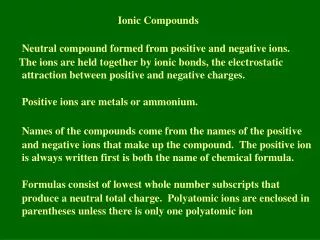
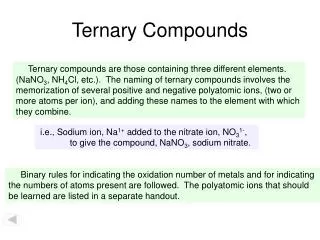
Ternary Ionic • Cation & Anion electrostatically held together • at least one of the ions is a polyatomic ion. • two or more atoms chemically bonded together with a charge – most are negative. • Polyatomic ions are listed on the back of the PT.
Create compounds • Same as for binary ionic • Method 1 – balance e- transferred • Method 2 – LCM • Method 3 – Crossover • Treat polyatomic ions as ONE unit • If you need more than one polyatomic ion, use parenthesis so subscript applies to all.
Naming • Same as binary ionic • Name the cation, name the anion
Sodium nitrate Lithium sulfate Calcium carbonate Magnesium chlorate NaNO3 Li2SO4 CaCO3 Mg(ClO3)2 Create compounds
Ammonium phosphate Potassium oxalate Barium hydroxide (NH4)3PO4 K2C2O4 Ba(OH)2