Mastering Continuous Random Variables for Statistical Analysis
Explore the intricacies of handling real-valued random variables and the distinction between probability mass and density functions in statistical analysis. Learn practical tips for managing continuous random variables effectively.

Mastering Continuous Random Variables for Statistical Analysis
E N D
Presentation Transcript
Continuous Random Variables (most slides borrowed with permission from Andrew Moore of CMU and Google) http://www.cs.cmu.edu/~awm/tutorials
Announcements • CS Welcome event • Thursday 3:30, ECCR 265 • poster presentations • Mozer lab research meeting • Wednesdays 11:00-12:30, ECCS 127 • Email me if you’d like to be on our mailing list
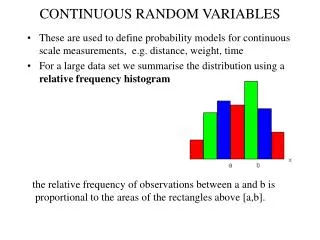
Real-Valued Random Variables • Previous lecture on probability focused on discrete random variables • true, false • male, female • freshman, sophomore, junior, senior • Can sometimes quantize real variables to make them discrete • E.g., age, height, distance • Today: how to handle variables that cannot be quantized
Probability Mass Vs. Density • Discreet RVs have a probability mass associated with each value of the variable • P(male)=.7, P(female)=.3 • Imagine if the variablehad an infinitenumber of valuesinstead of a finitenumber…
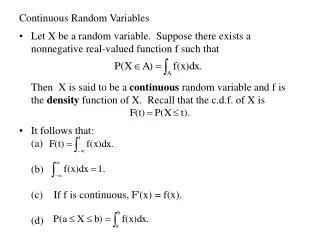
Probability Mass Vs. Density • Continuous RVs have a probability density associated with each value • Probability density function (PDF) • Density is derivative of mass • Notation: P(…) for mass,p(…) for density
Density estimate of automobile weight and MPG Note change innotation: Previously used P(x^y) for joint
Covariance Facts Consider 2D case with (X,Y) FALSE TRUE ? ?
Mike’s Basic Advice on Continuous Random Variables • Ignore the fact that p(x) is a probability density function and treat it just as a mass function, and the algebra all works out. • Alternatively, turn densities to masses with dx terms, and they should always cancel out. • Don’t be freaked when you see a probability density >> 1. • Do be freaked if you see a probability mass or density < 0.