Understanding CERN and the Large Hadron Collider: A Journey into Particle Physics
The Large Hadron Collider (LHC), operated by CERN (European Organization for Nuclear Research), is the world's largest and highest-energy particle accelerator. This monumental facility enables the study of fundamental particles by colliding protons at unprecedented energies. Since its successful launch on September 10, 2008, the LHC has made groundbreaking contributions to particle physics, including the discovery of the Higgs boson. This resource also highlights other notable colliders like Tevatron and proposed projects for future research.

Understanding CERN and the Large Hadron Collider: A Journey into Particle Physics
E N D
Presentation Transcript
CERN Supercollider By Alex Girardi
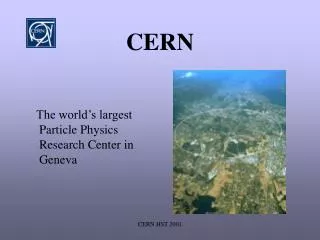
What is the Supercollider? • It’s large, and also called the Large Hadron Collider. • World’s Largest and highest energy particle accelarator.
What is CERN? • CERN is the European Organization for Nuclear Research. • Collaboration of thousands of scientists and engineers.
What has the LHC Done? • 10 Sept 2008 successfully fires protons around the entire tunnel. • 19 Sept 2008 Magnetic Quench occurs causing a loss of 6 tonnes of liquid helium.
Other Supercolliers • Isabelle • Tevatron • Relativistic Heavy Ion collider • Super large hadron collider (proposed 2019) • And a very large hadron collider (theorectical)