Core Web Vitals
The world of online purchasing moves quickly, so having a seamless and quick website experience is essential. Core Web Vitals, which evaluate variables like loading speed, interaction, and visual stability, are one tool to measure this. Comprehending and refining these essentials is crucial for Indian e-commerce businesses to maintain consumer satisfaction.

Core Web Vitals
E N D
Presentation Transcript
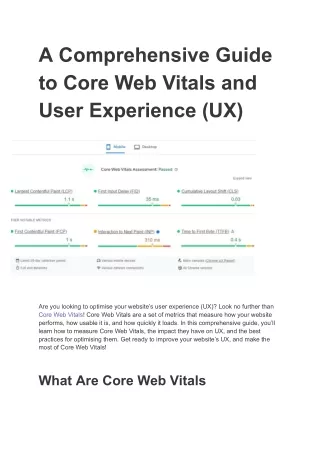
Boost Your Website's Performance: A Simple Guide to Core Web Vitals In today's digital world, having a website that performs well is crucial. Whether you run a business or share your thoughts through a blog, your website's performance can impact user experience and even your online presence. One key aspect to focus on its Core Web Vitals. But what are Core Web Vitals, and how can they boost your website's performance? Let's break it down. What are Core Web Vitals? Core Web Vitals are a set of user-focused metrics introduced by Google to measure the overall performance of a website. They focus on three essential aspects: loading, interactivity, and visual stability. 1. Loading (Largest Contentful Paint - LCP): This metric measures how fast the main content of your page loads. In simple terms, it's the time it takes for your website to show the most significant piece of content to the user. 2. Interactivity (First Input Delay - FID): FID gauges the responsiveness of your site. It assesses how quickly users can interact with your webpage, like clicking a button or filling out a form, after it loads. 3. Visual Stability (Cumulative Layout Shift - CLS): CLS evaluates the stability of your page's visual elements. If things are moving around unexpectedly as the page loads, it can lead to a poor user experience.
Why are Core Web Vitals important? Google considers Core Web Vitals when ranking websites in search results. A website that provides a better user experience is more likely to rank higher. Additionally, users are more likely to stay on a site that loads quickly and responds promptly to their actions. Tips to Improve Core Web Vitals: 1. Optimize Images: Large images can slow down your website. Compress and resize images to ensure they don't compromise loading speed. 2. Use a Content Delivery Network (CDN): A CDN helps distribute your website's content across multiple servers worldwide; reducing the time it takes to load for users in different locations. 3. Prioritize Critical CSS and JavaScript: Load essential styles and scripts first to speed up initial page rendering. 4. Minimize Server Response Time: Choose a reliable hosting provider and optimize your server to reduce the time it takes to respond to user requests. 5. Implement Lazy Loading: Load images and other non-essential elements only when they become visible to the user, improving initial page load times. 6. Browser Caching: Enable caching to store static files in users' browsers, reducing the need to download them with each visit. 7. Upgrade Hosting Plan: If your website experiences high traffic, consider upgrading your hosting plan to ensure it can handle the load efficiently. In Conclusion Boosting your website's performance with Core Web Vitals doesn't have to be complicated. By understanding and optimizing for LCP, FID, and CLS, you can enhance the overall user experience, improve search engine rankings, and keep your audience engaged. Remember, a faster, more responsive website is a step closer to success in the digital world.