The Development of Mesopotamian Societies and Hammurabi’s Law Code
Mesopotamia, known as the "land between rivers," was shaped by the Tigris and Euphrates Rivers, facilitating the rise of city-states in Sumer. These city-states operated independently, each governed by dynastic leaders intertwined with religious roles. Mesopotamian culture was polytheistic and marked by social hierarchies. Environmental challenges led to advancements in irrigation and architecture. Hammurabi’s Code, a pivotal legal framework, established justice principles that applied differentially to social classes. The region remained influential until the rise of other civilizations around 1500 B.C.

The Development of Mesopotamian Societies and Hammurabi’s Law Code
E N D
Presentation Transcript
Mesopotamia Ch. 2, Sec. 1 (pp. 29 - 34) SSWH1a: Describe the development of Mesopotamian societies: include the religious, cultural, economic, and political facets of society, with attention to Hammurabi’s law code.
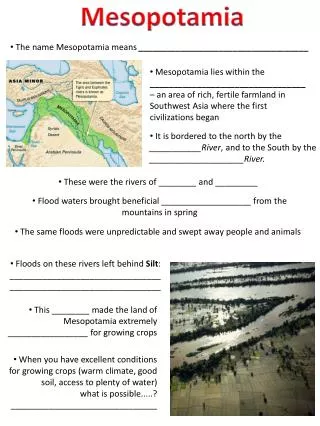
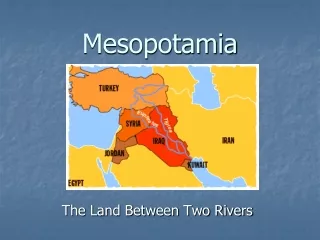
Geography & Background • In the modern Middle East are the Tigris & Euphrates Rivers • The land between these rivers and the land that lies along the eastern coast of the Mediterranean Sea form an arc of very fertile soil (known as the Fertile Crescent) • The land between the Tigris & Euphrates rivers is called Mesopotamia (which literally means “land between rivers”) • Remember, the city of Ur was located in Sumer, which itself was in Mesopotamia
Environmental Challenges • Unpredictable flooding • So they created irrigation ditches • No natural barriers for protection • So they built walls around their cities • Few natural resources • So they traded with their neighbors
Sumerians Create City-States • Sumerians built many cities • Cities each had their own government & rulers (similar to modern countries) • Cities & the surrounding lands were known as city-states (because they operated independently of one another) • Sumerian govt was usually led by both religion & military leaders • Leaders would often come from the same families (dynasties) • Sumerian ideas often spread to neighboring cultures (this process is called cultural diffusion) • In other words, if I’m worshipping a “Rain God” & my neighbor sees me doing this & starts worshipping the “Rain God” then cultural diffusion has occurred
Sumerian Culture • Sumerians were polytheistic (they believed in more than one god) • These gods were anthropomorphic, yet all-powerful & immortal • The afterlife was seen as very dismal • Social classes • (Highest class) kings, landholders & priests • Wealthy merchants • Manual laborers (field & workshop) • (Lowest class) Slaves (debtors & prisoners) • Technology • Base 60 number system • Architecture (arches, columns, ramps, etc.) • Cuneiform
Empire Building • From 3000 - 2000 B.C., Sumerians were almost constantly at war with one another • ~2350 B.C., Sargon (an Akkadian from the north) conquered Sumer & united northern & southern Mesopotamia for the first time • This union lasted ~200 years • ~2000 B.C., the Babylonian Empire (with its capital at Babylon) dominated Mesopotamia • The greatest ruler of Babylon was Hammurabi who created a single set of common laws for Mesopotamia • Hammurabi’s Code dealt with property issues, family issues, crime, etc. • The Code applied to everyone, but dealt differently w/ the rich & the poor • The Code frequently applied the principle “an eye for an eye & a tooth for a tooth”
The Fall of the Babylonians • ~1500 B.C., the Babylonian Empire fell to the neighboring Kassites • Many groups would later come to dominate Mesopotamia (Assyrians, Hebrews, Phoenicians, etc.) • While all this was going on, other people such as the Egyptians, Chinese & people of the Indus River Valley were experiencing the rise & fall of civilization