Download
1 / 16
160 likes | 292 Views
This guide explores the principles of experimental design, focusing on the cause-and-effect relationships in scientific experiments. It highlights key concepts such as independent and dependent variables, experimental and control groups, and the importance of random sampling. The guide uses practical examples, including hypotheses and variable definitions, to clarify the differences between these critical components. By mastering experimental design, students can effectively test hypotheses and analyze the outcomes of their research.

E N D
Experimental Design Showing Cause & Effect Relationships
Experiments • Direct way to test a hypothesis about a cause-effect relationship between factors
Experimental Group • The subjects in an experiment who are exposed to the treatment (independent variable) • Also called the experimental condition • The group being studied and compared to the control group
Control Group • Are not exposed to the independent variable • Results are compared to those of the experimental group • Also called the control condition
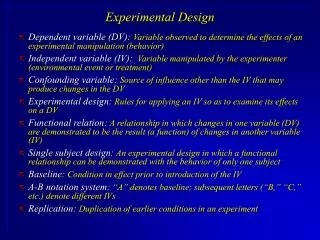
Independent Variable • The experimental variable which causes something to happen • The “cause variable” • The variable manipulated by the experimenter • The variable which should change the dependent variable
Dependent Variable • The experimental variable which is affected by the independent variable • The “effect variable” • The outcome of the experiment • The variable being measured
Mrs. Cavell’s Example: • Hypothesis: If I give teens “No Sleepy in Psychy” pill, then students should stay awake. • IV: No Sleepy in Psychy Pill • DV: Staying Awake • EG: Students taking the pill • CG: Students taking a placebo (sugar pill)
Which of the following is the Independent Variable in the statement: Justin Time wants to know if wearing a watch actually improves punctuality. • Justin Time • Punctuality • Wearing a Watch • None of the above.
Knowing the Difference • Use an If/Then Statement • If this (independent variable) THEN this happens (dependent variable). • If my subject drinks an energy drink (Ind. Variable) THEN they should get a surge in energy (Dep. Variable)
Experimental Design • Random sample—every member of the population being studied should have an equal chance of being selected for the study • Randomization helps avoid false results & bias • Double-Blind- Neither the researcher nor the participant knows if they are receiving the placebo
Dr. Mike Rophone was interested in the relationship between using a sound amplification device and student learning. Which of the following is the dependent variable? • Dr. Mike Rophone • Relationship • Student Learning • Sound Amplification Device
IF students eat breakfast THEN they will perform better in school. • IV: Eating Breakfast • DV: Performance in School • EG: Kids who EAT breakfast • CG: Kids who do NOT EAT breakfast
IF hummingbirds see red THEN they will be attracted to it. • IV: • DV: • EG: • CG:
IF bats use sound waves THEN they will locate food. • IV: • DV: • EG: • CG:
iBook batteries last for 5 hours. • IV: • DV: • EG: • CG:
Classwork: Create your own Word Problem! • Create 5 of your own LOGICAL hypothesis statement and fill in the appropriate variables! (10 points) • Tomorrow we will share these in class and then take a practice quiz on Thursday!