Markets, Demand and Supply
590 likes | 734 Views
This comprehensive overview of economic systems explores the classification of economies based on government control, including command, free-market, and mixed economies. Delving into the mechanisms of demand and supply, the text discusses how prices adjust in response to changes in market dynamics. It highlights the advantages and drawbacks of command economies and free markets, illustrating concepts like equilibrium price, interdependence of markets, and factors influencing demand. This analysis serves as a foundational understanding of how economies operate and respond to various stimuli.


Markets, Demand and Supply
E N D
Presentation Transcript
Economic Systems • Classifying economic systems • methods of classification • classification by degree of government control • command economies • free-market economies • mixed economies • other classifications • the informal economy • the not-for profit sector
Economic Systems • The command economy • features of a command economy • planning • consumption and investment • matching of inputs and outputs • distribution of output • Advantages of a command economy • high investment, high and stable growth • social goals pursued • low unemployment
Economic Systems • Problems of a command economy • problems of gathering information • expensive to administer • inefficient allocation of resources • inappropriate incentives • no system of prices • shortages and surpluses • lack of response to consumer demand
Economic Systems • The free-market economy • based on free decision making by individuals and firms • demand and supply decisions • the price mechanism • shortages and surpluses • shortage price rises • surplus price falls • equilibrium price • where demand equals supply • response to change in demand and supply
Economic Systems • Interdependence of markets • effect of a rise in demand • effect in market for that good
Sg Dg shortage (Dg > Sg) Pg Dg ¯ The price mechanism: the effect of a rise in demand Goods Market until Dg = Sg
Economic Systems • Interdependence of markets • effect of a rise in demand • effect in market for that good • effect in factor markets
Sf Sg Df shortage (Df > Sf) Pf Df ¯ The price mechanism: the effect of a rise in demand Goods Market Sg Dg shortage (Dg > Sg) Pg until Dg = Sg Dg ¯ Factor Market until Df = Sf
Economic Systems • Interdependence of markets • effect of a rise in demand • effect in market for that good • effect in factor markets • effect in other goods markets
Economic Systems • Interdependence of markets • effect of a rise in demand • effect in market for that good • effect in factor markets • effect in other goods markets • effect in other factor markets
Economic Systems • Interdependence of markets • effect of a rise in demand • effect in market for that good • effect in factor markets • effect in other goods markets • effect in other factor markets • Competitive markets
Economic Systems • Interdependence of markets • effect of a rise in demand • effect in market for that good • effect in factor markets • effect in other goods markets • effect in other factor markets • Competitive markets • perfectly competitive markets
Economic Systems • Interdependence of markets • effect of a rise in demand • effect in market for that good • effect in factor markets • effect in other goods markets • effect in other factor markets • Competitive markets • perfectly competitive markets • everyone is a price taker
Economic Systems • Interdependence of markets • effect of a rise in demand • effect in market for that good • effect in factor markets • effect in other goods markets • effect in other factor markets • Competitive markets • perfectly competitive markets • everyone is a price taker • why study perfect markets?
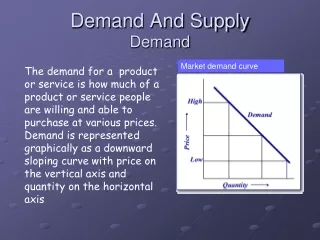
Demand • The relationship between demand and price • the income effect • the substitution effect • The demand curve • assumptions • the axes • illustrates how much would be demanded at each price
Market demand for potatoes (monthly) Market demand (tonnes 000s) 700 Point Price (pence per kg) 20 A Price (pence per kg) A Demand Quantity (tonnes: 000s)
Market demand for potatoes (monthly) Market demand (tonnes 000s) 700 500 Point Price (pence per kg) 20 40 A B Price (pence per kg) B A Demand Quantity (tonnes: 000s)
Market demand for potatoes (monthly) Market demand (tonnes 000s) 700 500 350 Point Price (pence per kg) 20 40 60 A B C C Price (pence per kg) B A Demand Quantity (tonnes: 000s)
Market demand for potatoes (monthly) Market demand (tonnes 000s) 700 500 350 200 Point Price (pence per kg) 20 40 60 80 A B C D D C Price (pence per kg) B A Demand Quantity (tonnes: 000s)
Market demand for potatoes (monthly) Market demand (tonnes 000s) 700 500 350 200 100 Point Price (pence per kg) 20 40 60 80 100 E A B C D E D C Price (pence per kg) B A Demand Quantity (tonnes: 000s)
Demand • Other determinants of demand • tastes • number and price of substitute goods • number and price of complementary goods • income • distribution of income • expectations • Movements along and shifts in the demand curve
An increase in demand D1 P Price D0 O Q0 Q1 Quantity
Supply • Relationship between supply and price • as price rises, firms supply more • it is worth incurring the extra unit costs • they switch from less profitable goods • in the long run, new firms will be encouraged to enter the market • The supply curve • assumptions • the axes • illustrates how much would be supplied at each price
Market supply of potatoes (monthly) Supply P 20 Q 100 a Price (pence per kg) a Quantity (tonnes: 000s)
Market supply of potatoes (monthly) Supply P 20 40 Q 100 200 a b Price (pence per kg) b a Quantity (tonnes: 000s)
Market supply of potatoes (monthly) Supply P 20 40 60 Q 100 200 350 a b c c Price (pence per kg) b a Quantity (tonnes: 000s)
Market supply of potatoes (monthly) Supply d P 20 40 60 80 Q 100 200 350 530 a b c d c Price (pence per kg) b a Quantity (tonnes: 000s)
Market supply of potatoes (monthly) e Supply d P 20 40 60 80 100 Q 100 200 350 530 700 a b c d e c Price (pence per kg) b a Quantity (tonnes: 000s)
Supply • Other determinants of supply • costs of production • profitability of alternative products • profitability of goods in joint supply • nature and other random shocks • aims of producers • expectations of producers • Movements along and shifts in the supply curve
S1 Shifts in the supply curve P S0 Increase O Q
S2 Shifts in the supply curve P S0 S1 Decrease Increase O Q
The Determination of Price • Equilibrium price and output • response to shortages and surpluses • significance of “equilibrium” • Demand and supply curves
The determination of market equilibrium(potatoes: monthly) e E Supply d D c C Price (pence per kg) b B a A a A Demand Quantity (tonnes: 000s)
The Determination of Price • Equilibrium price and output • response to shortages and surpluses • significance of “equilibrium” • Demand and supply curves • effect of price being above equilibrium
The Determination of Price • Equilibrium price and output • response to shortages and surpluses • significance of “equilibrium” • Demand and supply curves • effect of price being above equilibrium • surplus price falls
d D SURPLUS (330 000) The determination of market equilibrium(potatoes: monthly) e E Supply c C Price (pence per kg) b B a A Demand Quantity (tonnes: 000s)
The Determination of Price • Equilibrium price and output • response to shortages and surpluses • significance of “equilibrium” • Demand and supply curves • effect of price being above equilibrium • surplus price falls • effect of price being below equilibrium
The Determination of Price • Equilibrium price and output • response to shortages and surpluses • significance of “equilibrium” • Demand and supply curves • effect of price being above equilibrium • surplus price falls • effect of price being below equilibrium • shortage price rises
b B The determination of market equilibrium(potatoes: monthly) e E Supply d D c C Price (pence per kg) a A Demand Quantity (tonnes: 000s)
SHORTAGE (300 000) The determination of market equilibrium(potatoes: monthly) e E Supply d D c C Price (pence per kg) b B a A Demand Quantity (tonnes: 000s)
The Determination of Price • Equilibrium price and output • response to shortages and surpluses • significance of “equilibrium” • Demand and supply curves • effect of price being above equilibrium • surplus price falls • effect of price being below equilibrium • shortage price rises • equilibrium: where D = S
The determination of market equilibrium(potatoes: monthly) e E Supply d D Price (pence per kg) b B a A Demand Qe Quantity (tonnes: 000s)
The Determination of Price • Effects of shifts in the demand curve • movement along S curve and new D curve • rise in demand (rightward shift) P rises • fall in demand (leftward shift) P falls
Effect of a shift in the demand curve P S g Pe1 D1 O Qe1 Q
Effect of a shift in the demand curve P S g Pe1 D1 O Qe1 Q
Effect of a shift in the demand curve P S g Pe1 D2 D1 O Qe1 Q
i h Effect of a shift in the demand curve P S Pe2 g Pe1 D2 D1 O Qe1 Qe2 Q
The Determination of Price • Effects of shifts in the demand curve • movement along S curve and new D curve • rise in demand (rightward shift) P rises • fall in demand (leftward shift) P falls • Effects of shifts in the supply curve
The Determination of Price • Effects of shifts in the demand curve • movement along S curve and new D curve • rise in demand (rightward shift) P rises • fall in demand (leftward shift) P falls • Effects of shifts in the supply curve • movement along D curve and new S curve