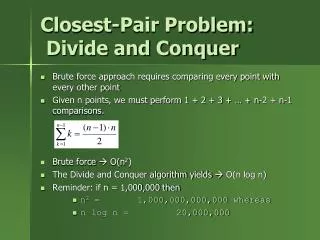
Analyzing the Divide and Conquer Approach to the Closest Pair Problem
130 likes | 290 Views
This document explores the Closest Pair Problem through the lens of the Divide and Conquer paradigm. It provides initial observations about the problem and details high-level strategies for its resolution. By correctly implementing the Closest Split Pair subroutine, we analyze the running time of the Closest Pair algorithm. The report emphasizes the importance of analyzing performance and correctness claims associated with these algorithms, leading to a deeper understanding of efficient design and analysis in computational geometry.


Analyzing the Divide and Conquer Approach to the Closest Pair Problem
E N D
Presentation Transcript
Divide and Conquer Closest Pair I Design and Analysis of Algorithms I
Suppose we can correctly implement the ClosestSplitPairsubrouine in time. What will be the overall running time of the Closest Pair algorithm? (Choose the smallest upper bound that applies.)