Direct Variation
Learn about direct variation and the constant of variation, also known as the constant of proportionality. Discover how to determine direct variation from equations, tables, and graphs.

Direct Variation
E N D
Presentation Transcript
Direct Variation Section 1.9
Notes: Direct Variation • When two variable quantities have a constant ratio, their relationship is called a ________________. • The constant ratio is called the _____________________. • The constant of variation is also known as the _____________________.
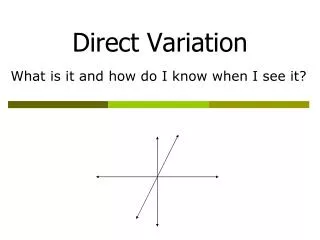
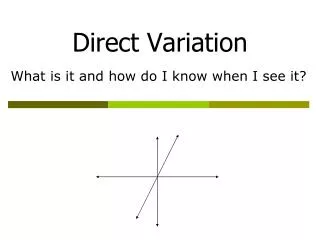
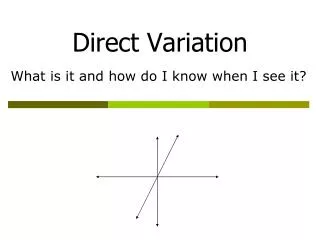
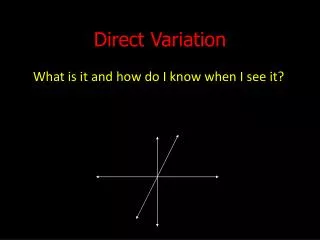
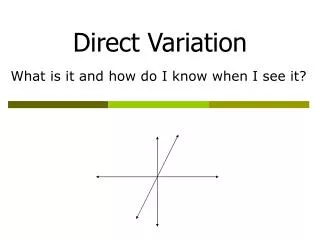
What is a Direct Variation? • A special equation in the form: y = kx • k is called the “constant of variation”; it is also the slope of the equation • The variables have a direct relationship; as one increases/decreases, so does the other • The graph of a direct variation always passes through the origin • Example: y = 3x
Determining a Direct Variation FROM EQUATIONS: • Put equation into form (y = ) and determine if it fits the pattern y = kx Are these direct variations? y = x y = 2x – 1 3x = 5y
Notes: Determine a Direct Variation • Not all situations with a constant rate of change are proportional relationships. • Likewise, not all linear functions are direct variations.
Determining a Direct Variation FROM TABLES: • Solve each ordered pair for k (k = y/x) • If k is constant for each ordered pair, you have a direct variation
Graphing Direct Variations • Always know 1 point on the line: (0,0) • Use k (the slope) to get additional points
Examples: Determine whether each linear relationship is a direct variation. If so, state the constant of proportionality 1.
Essential Question • How can you determine if a linear relationship is a direct variation from an equation? A table? A graph? • __________________________________________________________________________________________________________________________________________________________________________