Download
1 / 24
240 likes | 417 Views
Direct variation refers to a relationship between two variables where one variable is a constant multiple of the other. This can be expressed as (y = kx), where (k) is the constant of proportionality. As (x) increases, (y) increases proportionally, and as (x) decreases, (y) also decreases. By identifying the constant of proportionality through examples, learners can apply this concept to real-world problems, such as calculating wages based on hours worked or determining resource usage in varying scenarios.

E N D
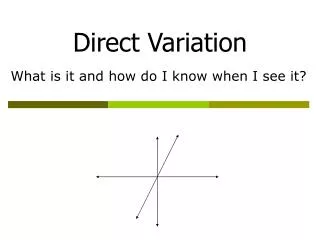
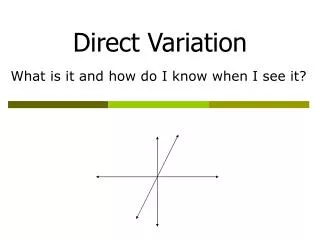
Direct Variation What is it and how do I know when I see it?
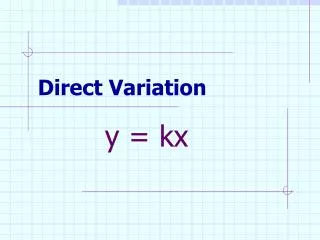
Definition: Y varies directly as x means that y = kx where k is the constant of proportionality. Another way of writing this is k = (Take notes – write this down) In other words: * As X increases in value, Y increases or * As X decreases in value, Y decreases.
Your Turn! • What is Direct Variation? • What happens when Y increases? • What happens when X decreases? • What is the formula? • What is the constant of proportionality?
Examples of Direct Variation: Note: X increases, 6 , 7 , 8 And Y increases. 12, 14, 16 What is the constant of proportionality of the table above? Since y = kx we can say Therefore: 12/6=k or k = 2 14/7=k or k = 2 16/8=k or k =2 Note k stays constant. y = 2x is the equation!
Your turn! • Explain how you would find the constant of proportionality
Examples of Direct Variation: Let’s assume that a girl has decided to baby sit for $5 per hour. Make a table of the baby sitters wages. Use X for the # of hours and Y for the wages. What is the constant of proportionality of the table above? Since y = kx we can say Therefore: 5/1=k or k = 5 10/2=k or k = 5 15/3=k or k =5 20/4=k or k =5 Note k stays constant. y = 5x is the equation!
Examples of Direct Variation: Note: X decreases, 30, 15, 9 And Y decreases. 10, 5, 3 What is the constant of proportionality of the table above? Since y = kx we can say Therefore: 10/30=k or k = 1/3 5/15=k or k = 1/3 3/9=k or k =1/3 Note k stays constant. y = 1/3x is the equation!
Examples of Direct Variation: Note: X decreases, 40, 16, 4 And Y decreases. 10, 4, 1 What is the constant of proportionality of the table above? Since y = kx we can say Therefore: 10/40 =k or k = ¼ y/x = ¼ or k = ¼ 4/16 =k or k = ¼ Note k stays constant. y = ¼ x is the equation!
Answer Now What is the constant of proportionality for the following direct variation? • 3 • 2 • ½ • 4
Is this a direct variation? If yes, give the constant of proportionality (k) and the equation. Yes! k = 6/4 or 3/2 Equation? y = 3/2 x
Is this a direct variation? If yes, give the constant of proportionality (k) and the equation. Yes! k = 25/10 or 5/2 k = 10/4 or 5/2 Equation? y = 5/2 x
Is this a direct variation? If yes, give the constant of proportionality (k) and the equation. No! The k values are different!
Answer Now Which is the equation that describes the following table of values? • y = 3x • y = 2x • y = ½ x • xy = 200
Using Direct Variation to find unknowns (y = kx) Given that y varies directly with x, and y = 28 when x=7, Find x when y = 52. HOW??? 2 step process 1. Find the constant variation k = y/x or k = 28/7 = 4 k=4 2. Use y = kx. Find the unknown (x). 52= 4x or 52/4 = x x= 13 Therefore: X =13 when Y=52
Using Direct Variation to find unknowns (y = kx) Given that y varies directly with x, and y = 3 when x=9, Find y when x = 40.5. HOW??? 2 step process 1. Find the constant variation. k = y/x or k = 3/9 = 1/3 K = 1/3 2. Use y = kx. Find the unknown (x). y= (1/3)40.5 y= 13.5 Therefore: X =40.5 when Y=13.5
Using Direct Variation to find unknowns (y = kx) Given that y varies directly with x, and y = 6 when x=5, Find y when x = 8. HOW??? 2 step process 1. Find the constant variation. k = y/x or k = 6/5 = 1.2 k = 1.2 2. Use y = kx. Find the unknown (x). y= 1.2(8) x= 9.6 Therefore: X =8 when Y=9.6
Using Direct Variation to solve word problems Problem: A car uses 8 gallons of gasoline to travel 240 miles. How much gasoline will the car use to travel 400 miles? Step One: Find points in table Step Three: Use the equation to find the unknown. 400 =30x 400 =30x 30 30 or x = 13.33 Step Two: Find the constant variation and equation: k = y/x or k = 240/8 or 30 y = 30x
Using Direct Variation to solve word problems Problem: Julie wages vary directly as the number of hours that he works. If her wages for 5 hours are $29.75, how much will they be for 30 hours Step One: Find points in table. Step Three: Use the equation to find the unknown. y=kx y=5.95(30) or Y=178.50 Step Two: Find the constant variation. k = y/x or k = 29.75/5 = 5.95
Direct Variation and its graph With direction variation the equation is y = kx Note: k is the constant therefore the graph will always go through…
Tell if the following graph is a Direct Variation or not. Yes No No No
Tell if the following graph is a Direct Variation or not. Yes No No Yes
Video 6 min Ratio word problem Discovery Education Using Proportions: Solving Word Problems • Video to understand unit rates Discovery Education – 3.45sec Turning a Table Into a Ratio and Variations on Rate Problems • Video Direct Variation use only first minute Direct and Inverse Variations -- Party Planning