Understanding Signal Transduction in Regulatory Systems
220 likes | 314 Views
Explore the intricate processes of signal transduction in regulatory systems, including chemotaxis, genetic exchange, and conjugation. Learn about sensor proteins, kinase activity, genetic engineering basics, and more.


Understanding Signal Transduction in Regulatory Systems
E N D
Presentation Transcript
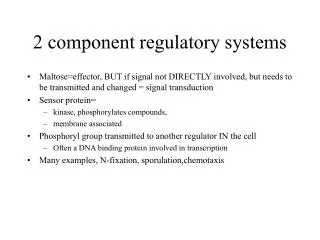
2 component regulatory systems • Maltose=effector, BUT if signal not DIRECTLY involved, but needs to be transmitted and changed = signal transduction • Sensor protein= • kinase, phosphorylates compounds, • membrane associated • Phosphoryl group transmitted to another regulator IN the cell • Often a DNA binding protein involved in transcription • Many examples, N-fixation, sporulation,chemotaxis
Chemotaxis • Attractants decrease rate of autophosphorylation • Repellant increased autophosphorylation • CheA-CheW=transducer • CheY controls switch • cheY-P tumbles, CCW-CW • CheB phosporylated by CheA-P, but slower response than CheY-P • CheB involved methylation • Fully methylated = best for repellants • cheB-P demethylates, occurs when attractants High • Degree of methylation regulates attraction/repulsion
Genetic exchange: plasmid transfer • Small, usually circular, independently replicating DNA molecules • Generally, G- plasmids replicate as does chromosomal DNA, G+ plasmids by “rolling circle” replication • Genes of replication control, timing initiation on plasmid (ori) • Some plasmids integrate (F+, Hfr) • Most are double-stranded • About 1- 100kb • Code for: • R-factors (R-plasmids) : antibiotic resistance, heavy metal resistance • Virulence plasmids : adhesins, hemolytic factors, toxin, Ti, bacteriocins • Degradation, tol, nah, • Plasmid copy # • Compatibility (inc)
Genetic exchange: plasmid transfer • Small, usually circular, independently replicating DNA molecules • Generally, G- plasmids replicate as does chromosomal DNA, G+ plasmids by “rolling circle” replication • Genes of replication control, timing initiation on plasmid (ori) • Some plasmids integrate (F+, Hfr) • Most are double-stranded • About 1- 100kb • Code for: • R-factors (R-plasmids) : antibiotic resistance, heavy metal resistance • Virulence plasmids : adhesins, hemolytic factors, toxin, Ti, bacteriocins • Degradation, tol, nah, • Plasmid copy # • Compatibility (inc)
Transformation • Competence: ability to be transformed • Steps in transformation • DNA binding and uptake (SS or DS, depending on species) • Integration (recA) • Competence may be induced by electroporation, Ca
Transduction • Generalized—can be carried out by either lytic or temperate phage • Specialized—requires specific integration
Conjugation: early Cell-surface structure
Genetic Engineering-basics • Basic steps in cloning • Restriction-modification enzymes • “shot gun” or PCR • Ligase • Recombination Plasmids (or phage)= vectors • Expression vectors • Selection of clones • Looking for a clone with a specific gene • Probes (DNA, RNA or antibody) • Wave of the future: DNA chips or “microarrays”, BAC libraries, automated sequencing etc
Genomics • Bioinformatics • Harvesting genes for biotech (Diversa) • Recent Science article • Comparing gene families