Download
1 / 6
60 likes | 161 Views
The Kingdom Animalia is characterized by eukaryotic cells, heterotrophic nutrition, and a multicellular structure, forming a blastula during development. Animals can be motile or sessile, with body symmetry described as asymmetrical, radially symmetrical, or bilaterally symmetrical. The body plan also includes orientation terms like dorsal, ventral, anterior, and posterior. Internal body cavities are classified as acoelomates, pseudocoelomates, or coelomates, reflecting different levels of complexity in animal structure. Understanding these characteristics provides insights into the vast diversity of animal life.

E N D
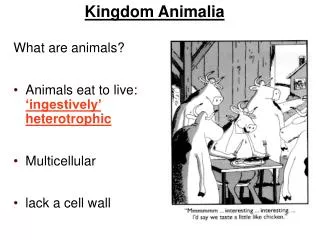
Characteristics of Animals • Eukaryotic cells – have a nucleus and membrane bound organelles • Heterotrophic – must ingest their food • Diploid – two copies of each chromosome • Multicellular – made of many cells • Forms a Blastula – a hollow ball of cells
Characteristics of Animals • Motile – can move during at least one stage of life • Some that do not move during a stage of life are called sessile See Visual Concepts Ch 28 “Reproduction in Jellyfish”
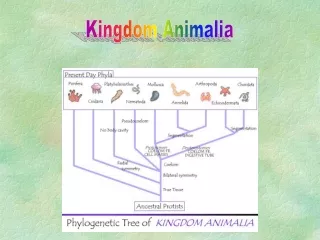
Animal Body Plan Animals are described according to their arrangement of body symmetry • Asymmetry - irregular shape • Radial symmetry - arranged around a central axis • Bilateral symmetry - there are distinctive right and left halves
Animal Body Plan Body Planes • Dorsal - upper • Ventral - lower • Anterior - front • Posterior - rear
Internal Body Cavity • Acoelomates – have no body cavity; filled with tissue (ex: flatworms) • Pseudocoelomates – have a body cavity located between the mesoderm and endoderm (roundworms) • Coelomate – have a true coelom, a body cavity located entirely within the mesoderm (segmented worms, and higher animals including humans) Ectoderm Mesoderm Endoderm