Download
1 / 22
220 likes | 344 Views
This study investigates the genetic diversity and conservation strategies for *Araucaria nemorosa*, an endangered tree species in New Caledonia. It highlights the impacts of human intervention on its restoration and explores the genetic bottlenecks that threaten its survival. By comparing genetic diversity from collected cones versus forest floor seeds, the research seeks to map the seed supply chain and propose strategies for effective germplasm collection and use. The ultimate goal is to maintain genetic diversity in ongoing restoration efforts for this critically endangered species.

E N D
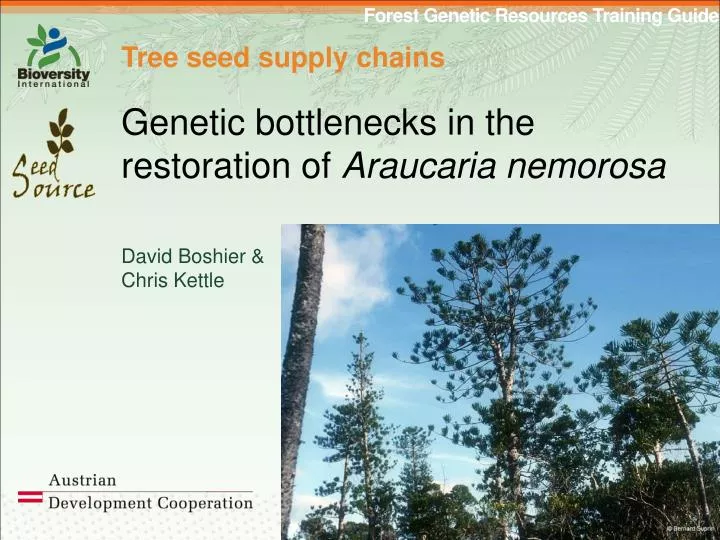
Tree seed supply chains Genetic bottlenecks in the restoration of Araucaria nemorosa David Boshier&Chris Kettle
What are the impacts of human interventions on trees? 13 of the 19 species of Araucaria
A. ruleiendangered A. muelleri lower risk – conservation dependent
Araucaria nemorosa– critically endangered (IUCN) monoecious flowers, self-compatible,wind pollinated, wind dispersed
Study Compared genetic diversity in plants from cones collected from trees vs seed from forest floor
How big is “big enough”? • 50/500 rule (Franklin 1980) • 50 - inbreeding depression to acceptable level • 500 - sufficient for new variation from mutation to replace that lost by genetic drift • refers to effective population size (Ne) rather than survey numbers (N) – so may need many more! • in trees Ne smaller than N due to: overlapping generations, dioecy, asynchronous flowering, fecundity differences between individuals
Genetic diversity, % rare alleles (<0.1), inbreeding coefficients in: adults (A), wild seedlings (W), nursery seedlings (N)
Theory genetic processes genetic drift gene flow mating - inbreeding selection • direct impacts • decrease pop. size • increase spatial isolation • decrease densities • change local environment
Your mission • draw out the seed supply chain • design a strategy for the collection and use of germplasm Objective – ensure the maintenance of genetic diversity in the on-going restoration efforts for this threatened species
How? • Step 1 - map out the seed/germplasm supply chain for A. nemorosa • Draw a flow diagram of the chain, from the source to the final user, within the field of restoration (from seed tree to a new plant in its final use). • The map should identify • players (individuals, institutions) and processes in the chain (what the players do) • influences of the chain on genetic variation (bottlenecks, selection, genetic drift) • limiting social factors in the chain (e.g. policies/laws, business, institutions or resources)
How? • Step 2 – analysis • What are the genetic risks associated with the actual system of seeds? • Specific recommendations to improve the situation, dealing with the diversity within the seed system (e.g. practical methods of collecting germplasm that ensure genetic diversity in restoration efforts)