Understanding Conditional Logic: A Comprehensive Overview
This lesson covers the fundamentals of conditional logic, focusing on statements, including conditional, biconditional, inverse, converse, and contrapositive statements. It explains how to formulate and analyze "if...then..." propositions, highlighting the importance of truth conditions. By examining relationships between angles, such as supplementary and congruent angles, and how these can be expressed conditionally, students will gain essential skills for logical reasoning. This summary provides examples and notes on the validity of converses and implications, ensuring a solid grasp of these concepts.

Understanding Conditional Logic: A Comprehensive Overview
E N D
Presentation Transcript
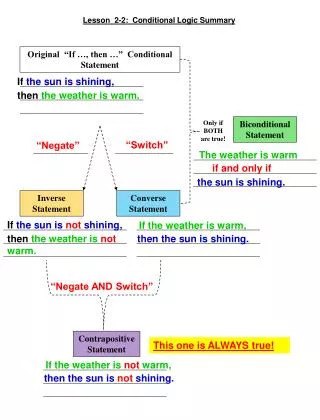
Lesson 2-2: Conditional Logic Summary Original “If …, then …” Conditional Statement Ifthe sun is shining, thenthe weather is warm. Only if BOTH are true! Biconditional Statement “Switch” “Negate” The weather is warm if and only if the sun is shining. Inverse Statement Converse Statement Ifthe sun is notshining, If the weather is warm, thenthe weather is notwarm. then the sun is shining. “Negate AND Switch” Contrapositive Statement This one is ALWAYS true! If the weather is notwarm, then the sun is notshining.
If … , then … hypothesis “If” conclusion “then” “2 angles form a linear pair” “the angles are supplementary” negate not not If 2 angles do not form a linear pair, thenthe angles are notsupplementary. hypothesis conclusion reword If2 angles are supplementary, thenthe angles form a linear pair. Note, the converse is NOT always true! Negate switch hypothesis conclusion If2 angles are NOTsupplementary,thenthe angles do NOT form a linear pair. original converse both true Two angles form a linear pair if and only if the angles are supplementary.
Two angles are congruent. The angle measures are equal. If two angles are NOT congruent, then their measures are NOTequal. If two angles have equal measures, then they are congruent. If two ’s do NOThave = measures, then they are NOTcongruent. Two angles are congruent if and only iftheir measures are equal. If a student gets an A, then a student passed Geometry. If a student plays soccer, then a student is an athlete. conditional today is Wednesday at SMHS, today is a block day. a shape is a three-sided polygon, a shape is a triangle. A shape is a quadrilateral, then a shape is a four-sided polygon.