Download
1 / 20
200 likes | 333 Views
This comprehensive overview details the properties of pure matter, differentiating between physical and chemical characteristics. Physical properties, such as boiling point, freezing point, and density, can be observed without changing the substance. In contrast, chemical properties, including reactivity and flammability, require a chemical reaction to be observed. The text explains the differences between compounds and mixtures and describes the behaviors of acids and bases, with examples of their reactions and properties. Essential knowledge for students and enthusiasts in chemistry.

E N D
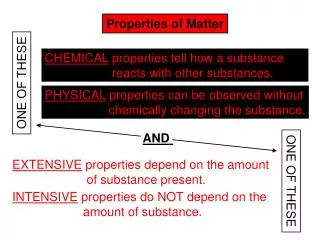
All Pure Matter has Physical Characteristics • Can observe without the substance changing into a new substance • Examples: boiling point, freezing/melting point, hardness, color, texture, & state at room temperature (gas, liquid or solid), density, solubility • If a metal: luster, malleability, conductivity of electricity and heat, attraction to magnet
If matter undergoes a physical change, then it is the same substance with the same physical and chemical properties before and after the change
Example: an ice cubemelts into liquid water and then can be boiled to make steam. • Each state has the same chemical formula (H2O), boiling and freezing/melting points, clear color, and is the universal solvent.
All Pure Matter has Chemical Characteristics • Can’t be observed just by looking at it • Describes a substance’s ability to turn into a new substance • To observe the property, the substance MUST react with another and form other pure substance(s), SO there must be a chemical reaction • Examples: flammability, reactivity with other elements and compounds (in the air iron forms rust, copper turns green, silver tarnishes)
If matter undergoes a chemical reaction, a new substance with its own physical & chemical properties is produced
Sodium (Na) - soft, silvery metal that explodes in water • Chlorine (Cl) - a poisonous yellow-green gas.
Chemical Reaction: sodium chloride (NaCl) • Na + Cl NaCl (table salt) • a white solid • dissolves in water without exploding • safe to eat • melting point of 801°C (Na 97.85°C) • boiling point of 1413°C (Cl -34.6°C).
Compounds vs. Mixtures • Molecules are substances with 2 or more atoms chemically combined. • A compound is a molecule made up of atoms from 2 or more elements that reacted chemically and has unique chemical properties of its own. (C6H12O6 or NH3) • All compounds are molecules, but not all molecules are compounds (some are elements like H2 or Cl2). • A mixture is made of 2 or more substances that do no react chemically, and retain their chemical properties (examples: salad, lemonade).
Chemical Properties of Acids • Tastes sour (if in food) • Reacts with metals and carbonates • Turns litmuspaper red • pH < 7 • Separate into H+ and (-) ions in water
Never Taste a Chemical in a Lab • Acids in foods taste sour or tart: citrus fruits, tomatoes, apples, vinegar
Acids React with Metals & Carbonates • Acids corrode metals • H+ react with the metal • Chemical reaction producing H2 – gas • Acids react with carbonates to produce CO2 (this is what happens in the reaction of baking soda and vinegar)
Strong Acid versus Weak Acid A strong acid releases more H+ into solution. A weak acid only partially dissolves in water
Chemical Properties of Bases Sodium Hydroxide - NaOHPotassium Hydroxide - KOHAmmonium Hydroxide - NH4OHCalcium Hydroxide - Ca(OH)2Magnesium Hydroxide - Mg(OH)2Barium Hydroxide - Ba(OH)2Aluminum Hydroxide - Al(OH)3 • Tastes bitter (if in food) • Feels slippery • Turns litmuspaper blue • pH > 7 (also called alkaline) • Causes OH- and (+) ions in water
Bases in food taste bitter: radish, cabbage, Brussels sprouts, turnip, olives, coffee, unsweetened cocoa, quinine, Tums®
pH = 7 • A substance with a pH of 7 is neutral • Closer to 7 = weak acids or bases • Closer to 0 – stronger acid (more acidic) • Closer to 14 = stronger base (more alkaline)
What Happens If An Acid & Base Mix? • The reaction between an acid and a base is called a Neutralization or oxidation-reduction reaction (redox) • Resulting substance has a pH closer to neutral (less acidic, less basic than the original substances) • acid + base = a salt + water • How close to pH 7 depends on the concentrations and amounts of the originals