Enhancing MCH Leadership Through Participatory Action Research: A Trainee Development Approach
This project explores the use of Participatory Action Research (PAR) in building leadership competencies among Maternal and Child Health (MCH) trainees. Participants engage in iterative research processes, collaborating with stakeholders to practice essential skills such as interdisciplinary teamwork, data collection, effective communication, and community engagement. The project emphasizes a trainee-led approach, encouraging individual strengths and perspectives while formulating research questions and presenting actionable recommendations. For more details, refer to the Guidebook on utilizing PAR for leadership development.

Enhancing MCH Leadership Through Participatory Action Research: A Trainee Development Approach
E N D
Presentation Transcript
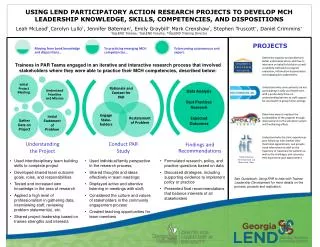
USING LEND PARTICIPATORY ACTION RESEARCH PROJECTS TO DEVELOP MCH LEADERSHIP KNOWLEDGE, SKILLS, COMPETENCIES, AND DISPOSITIONS Leah McLeod†,Carolyn Lullo†, Jennifer Bateman†, Emily Graybill+,Mark Crenshaw*, Stephen Truscott+, Daniel Crimmins+ †GaLEND Trainee; +GaLEND Faculty; *GaLEND Training Director PROJECTS Trainees in PAR Teams engaged in an iterative and interactive research process that involved stakeholders where they were able to practice their MCH competencies, described below: • Used interdisciplinary team building skills to complete project • Developed shared team outcome goals, roles, and responsibilities • Tested and increased own knowledge in the area of research • Applied a high level of professionalism in gathering data, interviewing staff, reviewing problem statement(s), etc. • Shared project leadership based on trainee strengths and interests • Used individual/family perspective in the research process; • Shared thoughts and ideas effectively in team meetings; • Displayed active and attentive listening in meetings with staff; • Considered the culture and values of stakeholders in the community engagement process • Created teaching opportunities for team members • Formulated research, policy, and practice questions based on data • Discussed strategies, including supporting evidence to implement policy or practice • Presented final recommendations that balance interests of all stakeholders See Guidebook: Using PAR to help with Trainee Leadership Development for more details on the process, projects and replication.