Understanding Scientific Notation: Key Concepts and Examples
This guide explores scientific notation, a method of expressing numbers as the product of a coefficient (1 ≤ a < 10) and a power of ten (10^n). We explain how to identify valid scientific notation, with examples such as 53 x 10^4 and 0.35 x 10^0. The guide also illustrates conversion between scientific and standard notation using examples like 1,430,000 = 1.43 x 10^6. Further, we demonstrate how to order numbers in scientific notation through step-by-step comparisons and conversions.

Understanding Scientific Notation: Key Concepts and Examples
E N D
Presentation Transcript
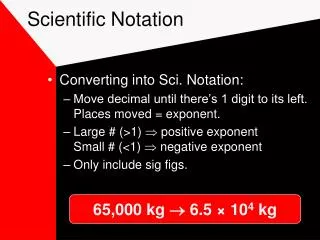
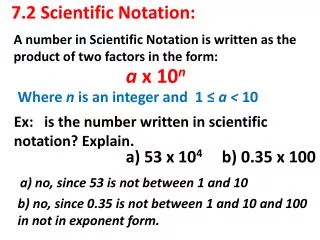
A number in Scientific Notation is written as the product of two factors in the form: a x 10n 7.2 Scientific Notation: Where n is an integer and 1 ≤ a < 10 Ex: is the number written in scientific notation? Explain. a) 53 x 104 b) 0.35 x 100 a) no, since 53 is not between 1 and 10 b) no, since 0.35 is not between 1 and 10 and 100 in not in exponent form.
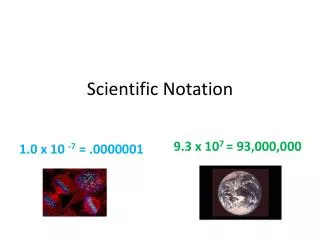
We can write the scientific notation: a) 0.00007 = 7 x 10⁻⁵ b) 1,430,000 = 1.43 x 10⁶ And we can also write the standard notation: c) 1.43 x 106 = 1,430,000 d) 7 x 10-5 = 0.00007
We can also order scientific notation numbers: a) 2.84x 10⁻⁴ b) 28 x 103 c) 0.025 x 10⁴ d) 258 x 10-5 To order scientific notation we must put in scientific notation with a number greater than 1 but less than 10 d) 2.84 x 10⁻⁴ a) 2.84x 10⁻⁴ b) 28 x 103 b) 2.8 x 10⁴ c) 0.025 x 10⁴ c) 2.5 x 10² d) 258 x 10-5 d) 2.58 x 10⁻³
We compare the scientific conversions but we arrange the original numbers. a) 2.84x 10⁻⁴ d) 2.84 x 10⁻⁴ b) 28 x 103 b) 2.8 x 10⁴ c) 0.025 x 10⁴ c) 2.5 x 10² d) 258 x 10-5 d) 2.58 x 10⁻³ 2.84x 10⁻⁴ , 258 x 10-5 , 28 x 103 . 0.025 x 10⁴ ,
CLASSWORK:Page 424-430 Problems: 11 through 45 (all the 2x+1)