Understanding Scientific Notation: Multiplication, Division, Addition, and Subtraction
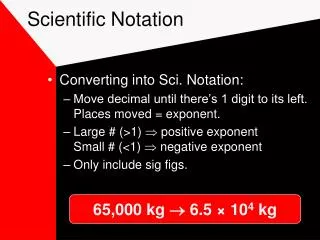
This guide explains how to perform operations using scientific notation, including multiplication, division, addition, and subtraction. For multiplication, multiply the numbers and add the exponents, as illustrated with examples like (2.1 x 10^15) x (2.0 x 10^10) = 4.2 x 10^25. For division, divide the numbers and subtract the exponents. Addition and subtraction require matching the exponents before operating on the numbers. Learn through clear examples that simplify these mathematical processes.


Understanding Scientific Notation: Multiplication, Division, Addition, and Subtraction
E N D
Presentation Transcript
MULTIPLICATION: MULTIPLY THE NUMBERS AND ADD THE EXPONENTS EX: (2.1 X 1015) X (2.0 X 1010) = (2.1 X 2.0) X 10 (15 + 10) = 4.2 X 1025 DIVISION: DIVIDE THE NUMBERS AND SUBTRACT THE EXPONENTS EX: (8.0 X 10¹⁵) 10) = (8.0 ÷4.0) X 1010) = 2.0 X 10⁵ FOR ADDITION AND SUBTRACTION ONE NUMBER MUST BE CHANGED SO THE EXPONENTS SO THE EXPONENTS OF BOTH ARE THE SAME AND THEN THE NUMBERS ARE ADDED OR SUBTRACTED. EX: (2.3 X 1050) + (3.0 X 1049) = (2.3 X 1050) + (0.3 X 1050) = 2.6 X 1050