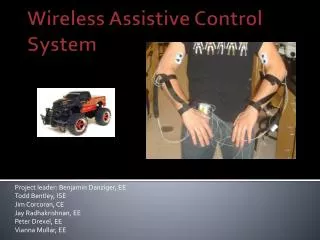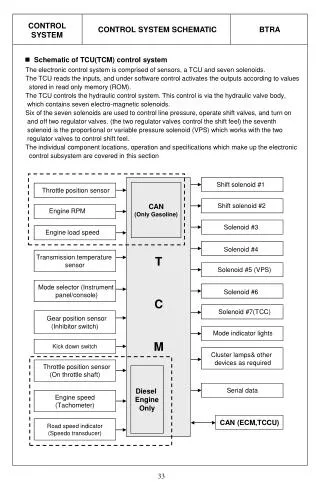
Wireless Assistive Control System
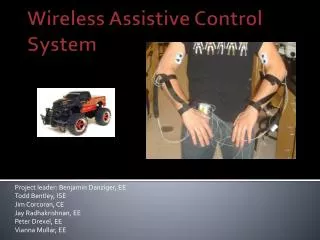
Design an interactive proof of concept that converts EMG signals into wireless commands to control an RC vehicle. Ensures safety and robustness for potential biomedical engineering students.

Wireless Assistive Control System
E N D
Presentation Transcript
Project leader: Benjamin Danziger, EE Todd Bentley, ISE Jim Corcoran, CE Jay Radhakrishnan, EE Peter Drexel, EE ViannaMullar, EE Wireless Assistive Control System
Project Criteria • Mission: Prove a control system can model bio-signals • Goal: Design an interactive proof of concept that prospective students can use at open houses • Purpose: show off the Biomedical Engineering Option Must be safe and robust! • Commissioned by the Electrical Engineering Department
Project Overview • RC Vehicle controlled by Electromyographic (EMG) signals • Convert surface EMG signals from human muscle to computer commands • Send commands wirelessly to an RC Vehicle
Customer Requirements • Strap • Eliminate movement artifact/transients/noise • Simplify electrode application • Signal Processing • Properly distinguish between the muscle groups • Robust Control Algorithm • Wireless Output • RC Vehicle • Bio-signals must control the vehicle's movements • Visual and Audible feedback
System Architecture Right Bicep Left Bicep BioRadio 150 TX BioRadio 150 RX USB Filter Right Thenar Control System Left Thenar RF Transmitter Lights DC Motor (Forwards/Backwards) MicroProcessor RF Receiver DC Motor (Left Right) Audio
Design Summary: Front End • Strap Design • Originally wanted glove-like design • Infeasible – 25 dimensions on human hand and arm • Anthropometric Design • Adjustable from 5th thru 95th percentile body types. • Expedites application of EMG sensors. • Nylon material construction • Incredibly durable • Nylon tubing hides wires and prevents movements
Design Summary: Front End • EMGs • Non-invasive, uses surface electrodes • Institute Review Board (IRB) • Need approval for human testing • Use of BioRadio • Collects up to 8 bio-signal channels (we’re using 4) • Safely collects all data • Transmits the data wirelessly
Data Acquisition Testing • Acquired data from 5 males and 5 females • Recorded Body Mass Index (BMI) • Tested Normal Weight, Overweight and Obese • Asked if they went to the gym • Ensured action could be performed and recorded by BioRadio150 on all individuals • Observe Crosstalk • Tested strap • Confirmed EMG frequency range • Fatigue Factor Muscle A Muscle B
Design Summary: Signal Processing Custom Moving Average Filter Normalization (Finds max value) Difference (Forward-Reverse) (Right-Left) Level Coding All on or All off • Customer Requirements met: • Channels distinguished • EMG based algorithm • Wireless output Data Packet
Design Summary: RC Vehicle • Receives commands by an RF Receiver • Powered by 6 NiMH AA batteries • Uses a ATtiny2313 Microprocessor • Uses two DC motors (one for turning, one for acceleration), each with its own H-bridge • Visual Feedback: Uses LED system • Audible Feedback: ChipCorder IC is used to play different sound effects correlating to the user’s actions
Design Summary: RC Vehicle Light Scheme on RC Car
Full System Testing • Live System Tests • Used all members of the team and several IRB participants • Ensured all 4 commands were functional • Drove car around the Wetlab
Budget • Final expenditure is $411.32 • Initial cost was $339.59 • Does not include the BioRadio • Budget~ $1000
Difficulties and Future Improvements • Future Improvements: • Electrode Pairs • Implement DSP • Use servo instead of DC motor • RC Vehicle with sharper turning radius • Difficulties: • Obtaining a clean signal • Parallel processing in “Real time”
Final Summary • Meets all Customer Requirements • Within budget • Cost= $411.32 • Budget~ $1000 • We will let YOU determine if it’s a success.
Questions? Do YOU have any Questions?