Download
1 / 8
110 likes | 287 Views
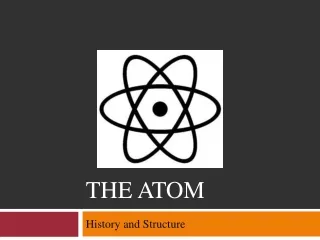
An atom is the basic building block of matter, defined as the smallest particle of an element that retains its properties. The atom consists of a dense nucleus containing protons and neutrons, which accounts for over 99% of its mass. Surrounding the nucleus are electrons, negatively charged particles in constant motion. This overview explores the structure of atoms, the roles of protons, neutrons, and electrons, and introduces the planetary model of the atom, illustrating the relationship between its components and the nature of matter.

E N D
Introduction to the Atom Protons, neutrons, electrons and the nucleus
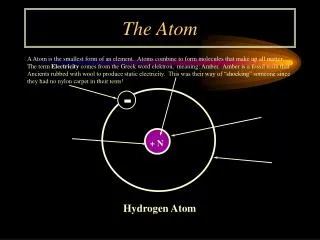
What is an atom? An atom is the smallest particle of an element that can be broken down and still have the characteristics of that element Basic building block of matter
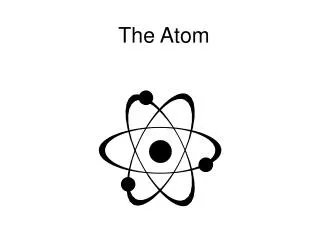
The Nucleus The nucleus of an atom is the positive dense core of the atom. Contains more than 99% of the atom’s mass.
3 Subatomic Particles • Atoms are composed of 3 subatomic particles: • Protons • Neutrons • Electrons
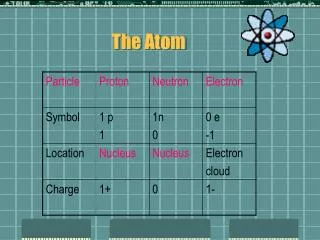
The Electron Negatively charged subatomic particle Discovered in 1897 by J.J. Thomson Symbol: e- Charge = -1 In constant motion orbiting nucleus
Protons • Positively charged subatomic particles • Discovered by Ernest Rutherford • Charge is equal but opposite that of an electron • Charge = +1 • Symbol: p+ • Located in nucleus
Neutrons Subatomic particle with no charge (neutral) Discovered by James Chadwick Mass equal to proton’s symbol : n0 Charge = 0 Located in nucleus