Download
1 / 6
70 likes | 256 Views
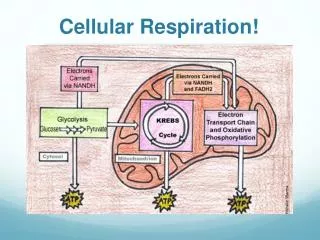
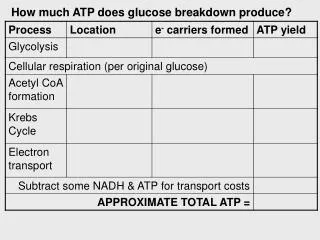
The breakdown of glucose through cellular respiration primarily occurs in two stages: glycolysis and the Krebs cycle. In glycolysis, which takes place in the cytoplasm, 2 ATP and 2 NADH are produced. During the Krebs cycle in the mitochondria, additional 2 ATP, 6 NADH, and 2 FADH2 are generated. The entire process yields 32-34 ATP when oxygen is present. In contrast, under anaerobic conditions, fermentation results in only 2 ATP from one glucose molecule. Understanding these pathways is crucial for studying cellular energy production.

E N D
How much ATP does glucose breakdown produce? cytoplasm 2 NADH 2 ATP Matrix of mitochondria 2 NADH 0 6 NADH 2 FADH2 Matrix of mitochondria 2 ATP 3 ATP per NADH 2 ATP per FADH2 Between compartments = 30 ATP = 4 ATP 32-34 ATP
How much ATP does glucose breakdown produce? Fermentation (per original glucose) Lactate Ethanol Cellular Respiration (Mitochondria)
How much ATP does glucose breakdown produce? Fermentation (per original glucose) cytoplasm 0 Lactate 0 cytoplasm Ethanol 0 0 Cellular Respiration (Mitochondria) 32-34 ATP
Where are processes happening? Input & output? 1 glucose 2 NADH glycolysis 2 ATP Krebs cycle 2 pyruvate 6CO2 2 acetyl CoA 2 NADH 6 NADH 2 FADH2 no O2 available 2 ATP fermentation E 32 ATP ethanol/ lactic acid matrix intermembrane space cytoplasm
Where are processes happening? Input & output? 1 glucose 2 NADH glycolysis 2 ATP Krebs cycle 2 pyruvate 6CO2 2 acetyl CoA 2 NADH 6 NADH 2 FADH2 no O2 available 2 ATP fermentation ETS 6O2 6H2O 32 ATP ethanol/ lactic acid matrix intermembrane space cytoplasm