Download

1 / 7
70 likes | 72 Views
Read the full blog here: https://bit.ly/3vMZR7g<br><br>Connect with us through:<br><br>Contact us : https://bit.ly/2IpPX7w<br>Facebook : https://www.facebook.com/PixelCrayons <br>Twitter : https://twitter.com/pixelcrayons <br>LinkedIn : https://www.linkedin.com/company/pixelcrayons<br>Instagram : https://www.instagram.com/pixelcrayons/ <br>Pinterest : https://in.pinterest.com/pixelcrayons/<br>

E N D
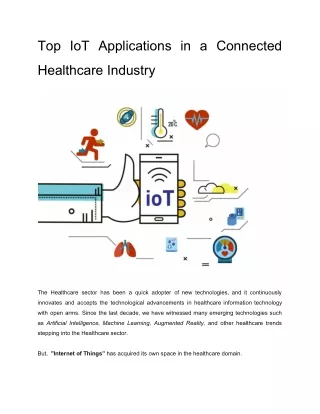
Top 5 Ways IoT is Turning the Healthcare Industry Upside Down Almost every aspect of our lives now generates data. Smartwatches track every step we take and detect every beat of our heart. The smartphones in our pockets know our location at all times, our hobbies, where we are going on vacation, and what we are thinking of buying. Some of these ideas benefit the customer and others help the manufacturer of the product. Ultimately, we are all emerging into an Internet of Things (IoT) world that, for the most part, benefits everyone, helping our everyday lives and staying connected to the things and people that are important to us. The Internet of Things includes a wide variety of smart devices, ranging from industrial machines, which transmit data from the production process to sensors that track information from the human body. IoT is everywhere, from retail to smart homes. By using IoT in healthcare, you can ensure patient care on time and attendance on time, reduce treatment costs, and make treatments more effective. Why is IoT crucial for the future? Businesses must adapt to trending technologies to stay ahead with a massive change in the tech world. IoT bridged the gap between physical and digital reality. A key aspect of IoT is that it facilitates real-time communication between devices and systems, which are miles apart. The market value of IoT is projected to be around $ 10 trillion by 2021.
IoT is also crucial because systems and devices with embedded sensors are linked to a network, which incorporates data from various devices and uses algorithms to exchange the most valuable information with applications designed to meet specific needs. These efficient IoT systems can determine precisely what information is useful and what can be safely overlooked. You can read more about top AI & machine learning companies here. IoT has made a place in our daily lives! -- Although the idea of IoT has been around for a long time, it has become practical through a collection of recent advancements in several different technologies. Businesses must adapt to emerging developments to stay ahead with a huge change in the tech world. It bridged the gap between physical and digital reality. A key aspect of IoT is that it facilitates real-time communication between devices and systems, which are miles apart. 1. Connectivity Internet network protocol hosts have facilitated rapid data transfer to link sensors to the cloud and other elements. Anyone with access to this technology who wants to manage this lock while sitting miles away can easily do so by connecting their electronic device. 2. Smart homes Smart Home has become the revolutionary ladder of residential success, and smart homes are expected to be as common as smartphones. The cost of owning a home is the most significant expense in the life of a head of household. Smart Home Products Promise to Save Time, Energy, and Money
3. Transportation The transportation industry is already collaborating with professional software development companies to make autonomous vehicles a possibility, increase efficiency, and reduce waste. 4. Connected cities Cities are also ideal incubators for IoT-based systems that make urban life more attractive, such as fast and accessible transportation systems, safe street lighting, and energy-efficient buildings. Impacts of IoT on the Healthcare Industry -- 1. Simultaneous reporting and monitoring Real-time monitoring through connected devices can save lives in a medical emergency such as heart failure, diabetes, asthma attacks, etc. With real-time monitoring of the condition by an intelligent medical device connected to a smartphone app, the connected devices can collect medical data and other necessary health data and use the smartphone's data connection to transfer the collected information to a doctor.
The Center of Connected Health Policy conducted a study indicating a 50% reduction in the readmission rate at 30 days due to remote monitoring of patients in heart failure. The IoT device collects and transfers data like blood pressure, oxygen, weight, and ECG. This data is stored in the cloud and can be shared with an authorized person, which could be a doctor, your insurance company, a participating health firm, or an external consultant, to allow them to view the collected data regardless of their place, time or device. 2. End-to-end connectivity and affordability IoT can automate patient care workflow with healthcare mobility solutions and other new technologies and next-generation healthcare facilities. IoT in healthcare enables interoperability, machine-to-machine communication, and data movement that make healthcare delivery effective. With the use of devices like Bluetooth, Wi-Fi, ZigBee, and other modern protocols, healthcare personnel can change how they detect diseases and ailments in patients and can also innovate revolutionary ways of treatment. Consequently, the technology-driven configuration reduces cost by reducing unnecessary visits, using better quality resources, and improving allocation and planning. Best mobile app development company in India 3. Tracking and alerts Early warning is essential in the event of life-threatening circumstances. IoT medical devices collect vital data and pass it on to doctors for real-time monitoring while notifying people about critical parts via mobile apps and other linked devices. Reports and alerts provide a strong opinion on a patient's condition regardless of time and place. It also helps to make well-informed decisions and to provide treatment on time. Thus, IoT enables real-time alerts, tracking, and monitoring, enabling practical treatments, increased precision, appropriate intervention by physicians, and improving comprehensive patient care outcomes. 4. Remote medical assistance In the event of an emergency, patients can contact a doctor many miles away with an innovative mobile app.
With healthcare mobility solutions, clinicians can instantly monitor patients and identify ailments on the go. Numerous healthcare delivery chains plan to build machines that can distribute drugs based on patient prescription and disease-related data available through connected devices. IoT will improve patient care in the hospital. This, in turn, will reduce the extent of medical care to people. 5. Enhanced Research IoT for healthcare can also be used for research purposes. This is because IoT allows us to collect a large amount of data about the patient's illness, which would have taken us many years if we had ordered it manually. This data thus collected can be used for statistical studies that would support medical research. Therefore, the IoT saves not only time but also the money that would go towards research. Therefore, IoT has a significant impact in the field of medical research. It allows the introduction of bigger and better medical treatments. IoT is used in a variety of devices that improve the quality of healthcare services that patients receive. Even existing devices are now being upgraded by IoT simply using embedded smart device chips. This chip improves the assistance and cares that a patient requires.
-- Challenges to overcome 1. Data security and privacy One of the essential threats posed by IoT is data security and privacy. IoT devices capture and transmit data in real-time. However, most IoT devices lack data standards and protocols. On top of that, there is significant ambiguity regarding data ownership regulation. These factors make our data highly susceptible to cybercriminals who can compromise the Personal Health Information (PHI) of both patients and doctors. Cybercriminals can misuse patient data to create false identifications to buy drugs and medical equipment that they can then sell. Hackers can also submit a fraudulent insurance claim on behalf of the patient. 2. Cost Are you surprised to see cost considerations in the challenge sections? This is because IoT has yet to make healthcare facilities affordable for the commoner.
The rise in healthcare costs is a worrying sign for everyone, especially for developed countries. The situation is so critical that it gave rise to "Medical Tourism," in which patients with critical conditions access health services in developing countries, which cost them less than a tenth. IoT in healthcare itself is a fascinating and promising idea. However, you have not resolved the cost considerations as of now. To successfully implement IoT application development and get its complete optimization, stakeholders must make it profitable. Otherwise, it will always remain out of reach for everyone except high-class people. Conclusion With this we come towards the end of our blog. I tried to combine all the studies I’ve done till now in the field of IoT and its impacts on different industries. If you are also a healthcare businessman looking to invest in an IoT based software product then now is your time. You just have to get in touch with the best IoT app development company in India and give your business the gift of success. If you have any other queries or suggestions, feel free to comment below.