Professional Teacher Education Unit (PTEU)
450 likes | 610 Views
Professional Teacher Education Unit (PTEU). Professional Teacher Education Unit (PTEU). 5 colleges Bagwell College of Education College of the Arts College of Health and Human Services College of Humanities and Social Sciences College of Science and Mathematics 15 departments


Professional Teacher Education Unit (PTEU)
E N D
Presentation Transcript
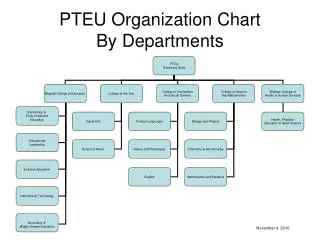
Professional Teacher Education Unit (PTEU) • 5 colleges • Bagwell College of Education • College of the Arts • College of Health and Human Services • College of Humanities and Social Sciences • College of Science and Mathematics • 15 departments • Teacher education is an all-campus responsibility • Dean of BCOE is head of the PTEU
KSU: University of Choice for Educator Preparation • 3rd largest university in the USG • Largest preparer of elementary teachers • 2nd largest preparer of teachers at all levels • PTEU completers have increased by 59% since Fall 2005 • Wide array of programs • First degree program beyond a master’s at KSU • First doctoral degree program at KSU
Responsive to State Initiatives and K-12 • Birth to Five B.S. • Traditional • Montessori • M.Ed. in Instructional Technology • STEM activities • Online Franchise MAT Program in Science and Mathematics • NSF grant – science • NSF grant - mathematics • Georgia DOE grant – science • Title II through UGA – online world of learning • Georgia Elementary Science Olympiad (largest in U.S.) • Advancing the Teaching of Mathematics in Science (ATOMS) Center
Responsive to State Initiatives and K-12 • Performance-based educational leadership programs • Ed.S. • PL-6 Certification (non-degree) • Reading as a critical mission in SREB states • Reading Endorsement • M.Ed in Reading • Reading Concentration in Middle Grades • KSU Annual Conference on Literature for Children and Young Adults • KSU Annual Conference on English as a Second Language • Kennesaw Mountain Writing Project • Center for Literacy and Learning
Teacher Quality Partnership Grant - $8.9 million • Addressing needs in Area 2 of CCSD • Developing 7 professional development schools • Developing undergraduate urban education option • Offering graduate level work to practicing teachers • Coaching Endorsement • Teacher Leader Endorsement • Linking achievement of K-12 students taught by KSU graduates to teacher education program
KSU Capital Campaign • Early Learning Center • New Building Addition
Collaborative Development of Expertise inTeaching, Learning and Leadership Conceptual Framework Theme:
Development of the Conceptual Framework • Collaboration with all stakeholders • Discipline Faculty • PTEU Faculty • Candidates (KSU students) • Graduates of our programs (Alumni) • Collaborating Teachers and Principals • Advisory Boards • Community Partners
What are the KSDs? • Knowledge • Skills • Dispositions
Outcomes- Initial - • Subject Matter Expert • Facilitator of Learning • Collaborative Professional Refer to handout for proficiencies that relate to each of these three outcomes
Subject Matter Expert Proficiencies • 1.1. Candidate demonstrates broad, in-depth, and current knowledge of discipline content. • 1.2: Candidate represents content accurately. • 1.3: Candidate connects content to other disciplines and applies it to common life experiences. • 1.4: Candidate uses pedagogical content knowledge effectively.
Facilitator of Learning Proficiencies • 2.1: Candidate demonstrates knowledge of how learners develop, learn and think. • 2.2: Candidate successfully motivates students to learn. • 2.3: Candidate creates and implements instruction that embodies multiple cultures and gives all students fair access to high quality education in a rich, diverse curriculum. • 2.4: Candidate creates effective, well-managed and active learning environments.
Facilitator of Learning Proficiencies • 2.5: Candidate creates a contextually-appropriate supportive environment where all students have an equitable opportunity for high achievement. • 2.6: Candidate designs effective instruction that reflects high expectations for all students and the belief that all students can learn. • 2.7: Candidate varies instructional strategies in response to individual needs of students. • 2.8: Candidate uses a variety of methods, materials, and technologies.
Facilitator of Learning Proficiencies • 2.9: Candidate utilizes a variety of strategies to assessstudent learning. • 2.10: Candidate uses the results of assessments to improve the quality of instruction.
Collaborative Professional Proficiencies • 3.1: Candidate communicates effectively orally and in writing. • 3.2: Candidate reflects upon and improves professional performance. • 3.3: Candidate builds collaborative and respectful relationships with colleagues, supervisors, students, parents and community members. • 3.4:Candidate displays professional and ethical behavior.
Birth to 5 Program (Traditional) • Preparation to work with children ages birth through kindergarten in a variety of settings • Global and diversity focus • Focus on infant and toddler instruction • Aligned with P-5 program • Emphasis on families and children with special needs • Developmental and diverse effective practices in the field of early care and learning
Birth to 5 Program (Montessori) • Preparation via research based education system to work effectively with children ages birth through kindergarten; • Sensori-motor preparation for cognitive development; • Individualized instruction to typically and atypically developing children; • Early learning during critical periods of development; • Global and diverse curriculum in a carefully prepared learning environment; • Aligned with the P-5 program.
CF Embraces Concepts Inherent In: • NCATE/PSC – Unit Standards • BOR Principles • Specialized Professional Association (SPA) Standards • PSC Program Rules • GA Framework • INTASC • NBPTS/ELCC/GLISI
CF Is Present In: Curriculum Syllabi Assessments
Common (Unit-level) Assessments • Candidate Performance Instrument (CPI) • Impact on Student Learning Assignment and Rubric (ISLA) • Portfolio Narrative and Rubric (PNR)
Program Specific AssessmentsInitial Programs • Content (GACE) • Content (2nd content) • Planning Assessment • Implementation (Clinical) Assessment • Student Learning Assessment • Dispositions Assessment • Optional – additional assessment • Optional – additional assessment
External VoicesFeedback From: • Student Teachers • Collaborating Teachers • Collaborating Principals • Graduates (Alumni) • Employers • Advisory Committees (unit & program levels)
Decision Points in Programs Acceptance at Decision Points Initial Programs • Admission to Teacher Education • Admission to TOSS/Practicum/IDA • Admission to Student Teaching • Exit from Student Teaching Advanced Programs: • Admission to Graduate Program • Mid Review • Exit from Program
Decision Points in Programs Acceptance at Decision Points Birth to 5 Program - Traditional: Admission to Teacher Education Admission to Methods Courses Admission to Student Teaching Exit from Student Teaching Birth to 5 Program – Montessori: Admission to University Admission to Teacher Education Admission to ECE 4355: Observation and Supervised Practice Teaching – Early Childhood II Exit from Program 28
Evidence Room Links • Unit Assessment System & Unit Assessments (see Standards 1 & 2) • Program Key Assessments (see PROBE) • Unit Decision Points (see Standard 2) • Program Specific Admission Requirements (see PROBE)
Unit Operations • Facilities, Library, Technology Resources • Support Services (e.g. Advisement, Admissions, Field Experiences) • Budgets • Personnel (Faculty, Staff, Administration) • Governance
Comprehensive Process Collection, Aggregation, Analysis, Reporting, & Reflection Of Useful Data
Chalk and Wire • A digital ePortfolio and assessment system that can support multiple unit and program assessment plans simultaneously. • Our purpose for C&W is to provide flexible yet connected assessment options for individual program areas.
Comprehensive Process Collection, Aggregation, Analysis, Reporting, & Reflection Of Useful Data
So What? Systematic Data Reflections Across the Unit
Form A - Individual Data Reflections Program: Semester/Year Evidence Collected: Name of Evaluator: *Provide the data source or name of assessment tool (e.g. CPI, advisory group, Principal Survey)
Electronic Evidence See Website