Innovative Ultra Wideband Wireless Sensor Grid for Enhanced Safety and Performance
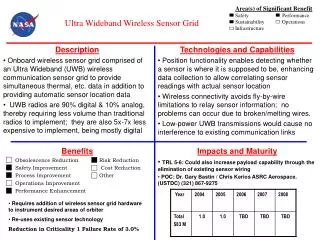
The Ultra Wideband (UWB) wireless sensor grid provides simultaneous thermal and location data, drastically improving operational safety and performance. By utilizing mainly digital UWB radios, the grid is smaller and more cost-effective, reducing installation expenses by 5x-7x compared to traditional radios. This innovative design enhances data collection and avoids issues commonly associated with wired sensors, such as failures from damaged wiring. With a technology readiness level of 5-6, this project aims to improve sensor reliability while lowering costs and risks.

Innovative Ultra Wideband Wireless Sensor Grid for Enhanced Safety and Performance
E N D
Presentation Transcript
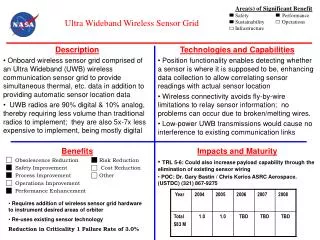
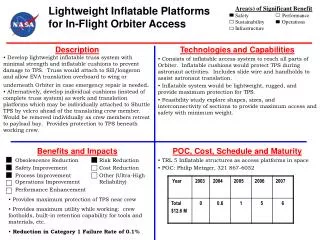
Area(s) of Significant Benefit Safety Performance Sustainability Operations Infrastructure Ultra Wideband Wireless Sensor Grid • Description • Onboard wireless sensor grid comprised of an Ultra Wideband (UWB) wireless communication sensor grid to provide simultaneous thermal, etc. data in addition to providing automatic sensor location data • UWB radios are 90% digital & 10% analog, thereby requiring less volume than traditional radios to implement; they are also 5x-7x less expensive to implement, being mostly digital • Technologies and Capabilities • Position functionality enables detecting whether a sensor is where it is supposed to be, enhancing data collection to allow correlating sensor readings with actual sensor location • Wireless connectivity avoids fly-by-wire limitations to relay sensor information; no problems can occur due to broken/melting wires. • Low-power UWB transmissions would cause no interference to existing communication links Benefits Obsolescence Reduction Risk Reduction Safety Improvement Cost Reduction Process Improvement Other Operations Improvement Performance Enhancement • Impacts and Maturity • TRL 5-6: Could also increase payload capability through the elimination of existing sensor wiring • POC: Dr. Gary Bastin / Chris Kerios ASRC Aerospace. (USTDC) (321) 867-9275 • Requires addition of wireless sensor grid hardware to instrument desired areas of orbiter • Re-uses existing sensor technology • Reduction in Criticality 1 Failure Rate of 3.0%
Ultra Wideband Wireless Sensor Grid • Total Project Costs: $ 2.0 M • Feasibility: $ 0.5 M • Formulation: $ 1.5 M (feasibility model) • Implementation: $ TBD (full scale not priced) • Project Submitted By: Dr. Gary Bastin / Chris Kerios • ASRC Aerospace. (USTDC)