Understanding Ecosystems: Interactions Between Biotic and Abiotic Factors
This guide explores the fundamental concept of ecosystems in ecology, highlighting the interplay of living organisms (biotic factors) and their nonliving environment (abiotic factors). It delves into the structure of ecosystems with examples such as tropical rainforests, savannas, and deciduous forests. Key concepts include the roles of producers, consumers, and decomposers in food webs, as well as the importance of population dynamics in ecological studies. Engaging in group activities, learners will observe local ecosystems and document their findings, deepening their understanding of ecological relationships.

Understanding Ecosystems: Interactions Between Biotic and Abiotic Factors
E N D
Presentation Transcript
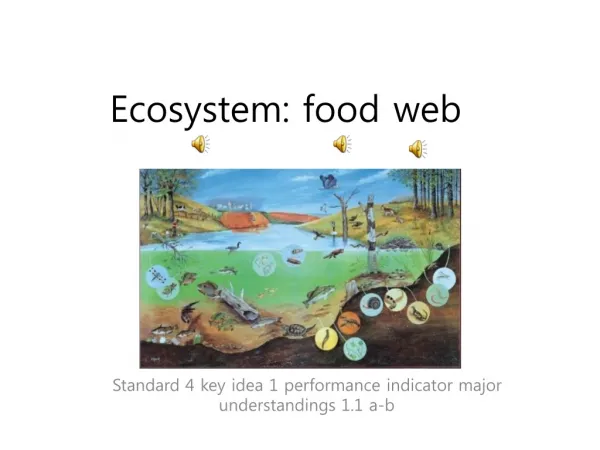
Ecosystem: food web Standard 4 key idea 1 performance indicator major understandings 1.1 a-b
Ecosystem the basic unit of study in ecology, including the plant and animal community in interaction with the nonliving environment. Ecosystem=+ Living Organisms (biotic) Nonliving environment where the organisms live (abiotic)
Examples of ecosystems • Tropical rain forest ecosystem
Examples of ecosystems Savanna ecosystem http://morriscourse.com/elements_of_ecology/chapter_23.htm
Examples of ecosystems Deciduous forest ecosystem http://www.123rf.com/photo_11151531_colorful-autumnal-landscape-with-deciduous-forest-and-many-fallen-leaves.html
Population All the members of a particular species in a given geographical location at a given time. Example: Bird population around Onondaga lake http://letsgowalking.ca/?tag=water-birds
Populations can be categorized by the function they serve. (i.e. producers, consumers, and decomposers) http://churchillscience.edublogs.org/tag/decomposers/
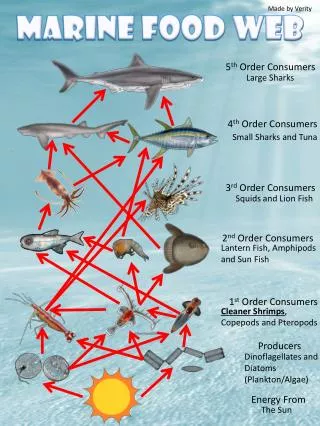
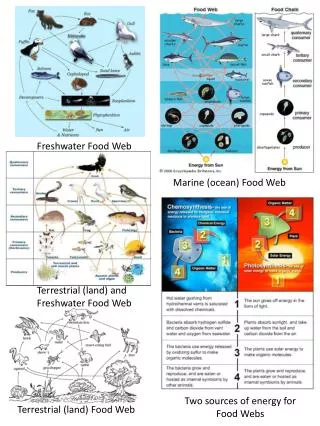
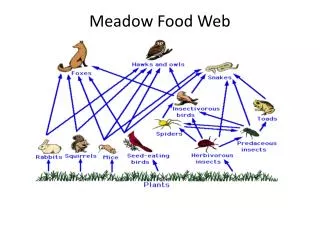
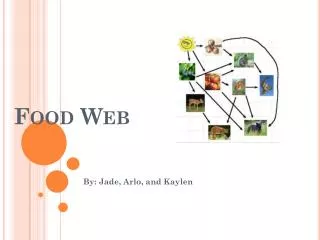
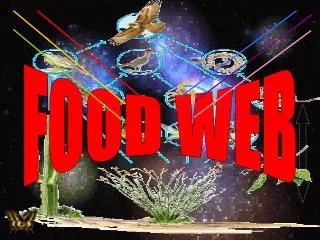
Food web a complex interconnection of all the food chains in an ecosystem. http://deeptech.org/broadband-ecosystems/
Food webs identify the relationships among producers, consumers, and decomposers carrying out either autotrophic or heterotrophic nutrition.
Autotrophic nutrition: A type of nutrition in which organisms manufacture their own organic foods from inorganic raw materials. Heterotrophic nutrition: A type of nutrition in which organisms must obtain their foods from outside sources of organic nutrients.
Producer An autotrophic organism capable of trapping light energy and converting it to the chemical bond energy of food (for example, green plants; the organisms forming the basis of the food chain. http://www.bbc.co.uk/bitesize/ks3/science/organisms_behaviour_health/food_chains/revision/6/
Consumer Any heterotrophic animal organism (for example, human being).
Decomposer Any saprophytic organism that derives its energy from the decay of plant and animal tissues (for example, bacteria of decay, fungus); the final stage of a food chain. http://ww2.valdosta.edu/~rkbryant/ebook4.html http://ecology5thperiod.wikispaces.com/Decomposers http://www.vetcheryl.com/2012/11/decomposer-close-up/
Group activity Let’s go outside and observe an ecosystem. 1) Take pictures of what you see. Take pictures of at least three different producers, three different consumers, and three different decomposers. Later, you will create a food web using the pictures. 2) Find five biotic factors and five abiotic factors and write them down.